
%20(1).webp)
Despite heavy investments in digital systems, hospitals still struggle with inefficient appointment scheduling, high cost per interaction, and fragmented patient journeys.
The issue is not a lack of technology; it's the absence of intelligent workflow automation capable of executing real actions within daily operations.
This is where AI in healthcare becomes a strategic necessity.
AI in Healthcare: Concept & Impact
AI in healthcare refers to the use of intelligent systems to enable healthcare automation, optimize operations, and enhance patient engagement.
From appointment scheduling automation and medical records management to advanced analytics and conversational AI, the goal is not to replace healthcare professionals, but to empower them.
According to npj industry insights, AI can significantly reduce operational costs by improving efficiency, minimizing administrative overhead, and supporting data-driven decision-making.
Why Hospitals Still Struggle Despite Digital Transformation
Digital transformation alone does not guarantee operational efficiency. While many healthcare organizations have invested heavily in digital tools and systems, the expected improvements in performance and patient experience often fall short.
The challenge is not the lack of technology, but how that technology is implemented, integrated, and aligned with real operational needs.
Key challenges include:
- Fragmented patient journeys across disconnected systems
- Inefficient scheduling processes causing delays and no-shows
- Rising cost per interaction due to manual operations
- Limited integration, leading to data silos
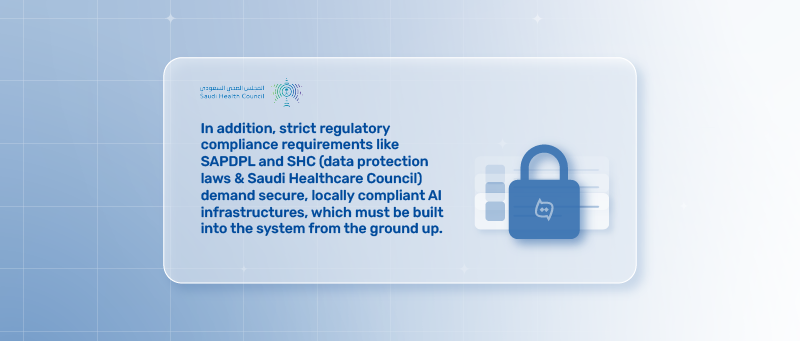
- Increasing regulatory and compliance pressures
The result is a gap between investment and real impact. Many organizations operate multiple systems but still struggle to achieve efficiency, scalability, or a consistent patient experience; leaving technology as isolated tools rather than true enablers of transformation.
How AI is Reshaping the Patient Journey
The real shift happens when organizations move from response to execution through AI solutions for healthcare
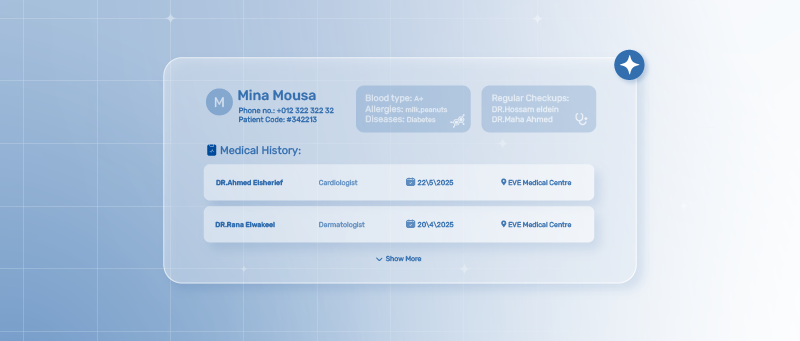
Before AI:
- Manual interactions
- Delayed responses
- Inconsistent patient experience
After AI:
- Instant responses powered by NLP
- Real-time execution (booking, rescheduling, follow-ups)
- Unified omnichannel experience
Impact:
- Reduced waiting time
- Improved patient satisfaction
- Lower cost per interaction
This is the core of healthcare automation.
Looking for scalable enterprise AI solutions that deliver real operational impact?
Book a meeting and explore how AI can transform your healthcare workflows.

Why the Arab Healthcare Market Needs Specialized AI
Most global AI healthcare solutions are built for Western markets, creating a major gap in Arabic-speaking environments.
Patients communicate in diverse dialects (Saudi, Egyptian, Gulf, Levant), and expect accurate understanding. Systems that fail to capture this nuance lead to poor outcomes and miscommunication.
WideBot addresses this with Arabic-native AI models that understand 25+ dialects, ensuring contextual accuracy across real healthcare scenarios.
Key Applications of AI in Healthcare
Modern AI in healthcare are not standalone tools, they are integrated systems across the entire operational flow.
Appointment Scheduling Automation & Patient Journey Management:
AI agents enable patients to book, reschedule, and explore services instantly via WhatsApp or web channels.
Automated reminders reduce no-show rates and improve overall experience:
- Electronic Health Record Integration
AI integrates seamlessly with EHR systems, ensuring real-time data updates without manual input.
- Workflow Automation & Operational Efficiency
From lab results delivery to insurance confirmations
- Reduced administrative workload (up to 40%)
- Faster processing
- Improved staff productivity
Data-Driven Decision Making:
AI analyzes operational and patient data to generate insights that support better clinical and business decisions.
How Healthcare Organizations Can Get Started
Successfully adopting AI in healthcare is not about deploying the most advanced technology, but about identifying where it can create the most immediate and measurable impact.
Start by identifying high-friction areas; where patients drop off, where staff spend time on repetitive tasks, and where costs are highest. These points define your starting priorities.
From there, focus on:
- High-impact use cases like appointment scheduling and patient inquiry automation
- Optimizing the full patient journey, not just isolated touchpoints
- Reducing cost per interaction through scalable, automated workflows
- Using Arabic-first AI models that understand dialects and context
- Ensuring regulatory compliance from the start to protect data and trust
Ultimately, the organizations that succeed are not those adopting more tools, but those embedding AI as a core operational layer across their workflows—not just an added feature.
Voice AI: The Next Generation of Patient Experience
Patient communication is no longer limited to text messages or online booking forms. Today, voice AI agents can handle patient calls, understand inquiries in local dialects, and execute requests instantly, without waiting time or human intervention.
Key capabilities include:
- Handling incoming patient calls and understanding requests in local dialects
- Instantly confirming appointments and routing inquiries to the right department
- Sending automated follow-ups and reminders without delays
The real advantage, however, lies in contextual understanding. Voice AI models trained on real Arabic data can distinguish between dialects, whether a patient is speaking from Riyadh or Cairo, and interpret intent with greater accuracy. This results in fewer errors, faster processing, and a more natural patient experience.
From an operational perspective, this allows healthcare providers to operate 24/7 with consistent efficiency, while reducing reliance on large call center teams. As demand increases, the system scales automatically, maintaining service quality without added operational complexity.
Conclusion: From Automation to Transformation
AI in healthcare is no longer optional, it’s operational infrastructure.
Organizations adopting AI today are:
- Reducing costs
- Enhancing patient experience
- Improving efficiency at scale
The shift is clear:
From tools → to systems
From responses → to execution
From automation → to transformation
.webp)
FAQ's related to AI in Healthcare
What is AI in healthcare and how is it applied?
It means using intelligent systems to automate workflows, improve the patient journey, and reduce cost per interaction across hospitals.
How does AI improve the patient journey?
Through automation, real-time responses, and personalized interactions powered by NLP and data analysis.
Can AI handle Arabic dialects in healthcare environments?
Yes, when trained on diverse Arabic datasets, AI can accurately understand multiple dialects and medical contexts.
How does AI ensure regulatory compliance?
Through secure data handling, encryption, and alignment with healthcare data protection standards.
What is a realistic timeline for AI implementation in hospitals?
Organizations typically see measurable results within 60–90 days when starting with focused use cases like appointment scheduling automation.




.webp)
.webp)
.webp)
