
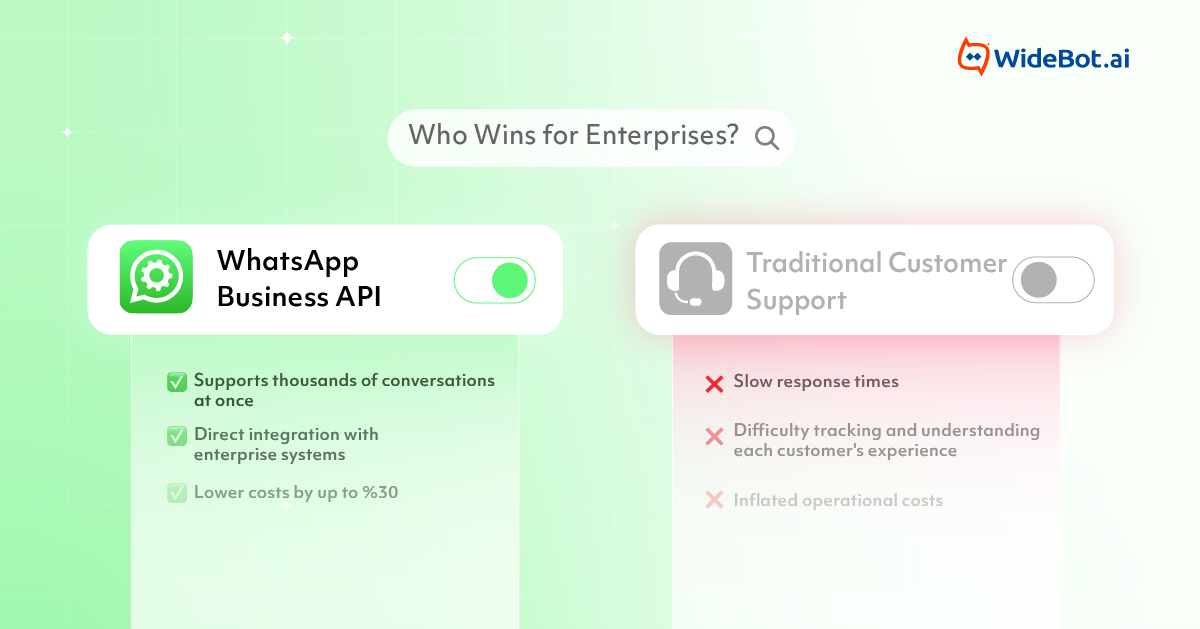
Most large organizations struggle with three major customer support challenges:
- Slow response times
- High operational costs
- Difficulty tracking and understanding each customer’s journey
Considering that 71% of customers communicate with businesses through WhatsApp, and 50% prefer it as an official communication channel, according to a study published by The Standard, an important question arises:
Can WhatsApp Business API effectively solve these challenges?
Or does traditional customer support still maintain its competitive advantage?
In this article, we provide a detailed comparison between both approaches, supported by real-world use cases from industries such as banking, real estate, insurance, and telecommunications, helping organizations make the right decision.
What Is WhatsApp Business API?
WhatsApp Business API is a software solution developed by Meta that enables organizations to communicate with customers through WhatsApp in an automated, scalable, and structured manner.
Through the API, businesses can:
- Automate messages and responses
- Provide customer support
- Process transactions
- Send notifications
- Scale customer communication through the world's most widely used messaging platform
An API (Application Programming Interface) is a set of protocols and rules that allows different software applications to communicate with one another.
According to statistics from TimelinesAISobot, companies that adopted automation through WhatsApp Business API reduced traditional support costs by as much as 30%.
WhatsApp Business API enables organizations to:
- Support customers through multiple agents using a shared inbox
- Deploy WhatsApp chatbots to instantly answer frequently asked questions
- Integrate with internal CRM systems for better tracking and personalized service
In contrast, traditional customer support relies on channels such as phone calls, email, or in-person service, making it slower, more expensive, and less scalable.
WhatsApp Business API vs. Traditional Customer Support
Comparative Overview
WhatsApp Business API provides:
- Instant communication
- Automated workflows
- CRM integration
- 24/7 availability
- Lower operational costs
- High scalability
Traditional support offers:
- Human interaction
- Personalized conversations for complex issues
- Limited availability
- Higher operating costs
- Longer response times
Most Common Use Cases Across Industries
1. Banking Sector
WhatsApp Business API enables banks to conduct secure and intelligent customer interactions at scale, reducing pressure on contact centers and improving customer satisfaction.
Use Cases:
- Sending banking updates and notifications through WhatsApp
- Integrating customer communications with the bank’s CRM
- Automated responses for common inquiries such as:
- Account balance inquiries
- Card blocking requests
- Transaction confirmations
Results:
- Reduced traditional support team workload by up to 20%
- Improved customer satisfaction
- Seamless transfer between chatbots and human agents when needed
2. Real Estate Sector
Real estate agencies can automatically send:
- Property visit confirmations
- Appointment reminders
- Promotional property videos
According to published statistics, WhatsApp messaging costs in Saudi Arabia are approximately $0.0195 per message after the first 1,000 free monthly messages.
Results:
Many agencies have adopted a WhatsApp-first automation model, where chatbots qualify leads before transferring them to sales agents, significantly reducing communication costs and response times.
3. Insurance and Telecommunications
Insurance companies use WhatsApp API to:
- Send payment reminders
- Provide claim status updates
- Integrate communications with CRM systems
Telecommunications providers use chatbots to:
- Manage customer complaints
- Recommend suitable plans
- Guide customers through support processes
These examples demonstrate how WhatsApp automation, chatbots, and CRM integration work together to improve customer satisfaction and reduce response times.
CRM Integration and Customer Engagement
Organizations can integrate WhatsApp Business API with CRM systems through the following steps:
- Centralize all customer conversations within a single CRM platform
- Track customer history and behavior to personalize responses
- Integrate ERP systems for automated updates
- Create automated alerts for events such as:
- New requests
- Project milestones
- Contract renewals
WideBot AI provides a complete WhatsApp Business API solution that combines WhatsApp API capabilities, AI-powered chatbots, and integration with enterprise systems, helping organizations improve CRM performance, customer support quality, and response times.
Key Benefits of WhatsApp Business API for Enterprise Customer Service
Instant Automated Responses
AI-powered chatbots operate around the clock, delivering accurate answers to customer inquiries.
Flexible Support Team Management
Conversations can be automatically distributed among support teams to improve efficiency and reduce wait times.
Personalized Customer Communication
Messages can be tailored based on customer status, history, and preferences.
Integration with Internal Systems
Direct integration with CRM, ERP, and other enterprise systems enables seamless workflows.
High Open Rates
WhatsApp messages achieve open rates exceeding 90%, making it one of the most effective communication channels available.
Advanced Analytics
Real-time reporting on customer satisfaction, performance metrics, and operational efficiency supports continuous improvement.
These capabilities make WhatsApp Business API a strategic solution for delivering scalable, high-quality customer experiences.
Conclusion
For most modern organizations, WhatsApp Business API clearly emerges as the stronger solution because it enables:
- Better customer experiences and higher satisfaction
- Significant reductions in response times
- Lower operating costs
- Easy integration with CRM systems
- Scalable customer communication
- 24/7 support availability without substantial additional costs
Traditional customer support still plays an important role in handling highly complex, sensitive, or relationship-driven interactions. However, it lacks the flexibility, scalability, and efficiency that modern enterprises increasingly require.
Organizations seeking to modernize customer engagement and integrate WhatsApp Business API with chatbots and CRM systems can significantly improve operational efficiency, customer satisfaction, and digital service delivery.
FAQ's about WhatsApp Business API:
1. What is WhatsApp Business API?
WhatsApp Business API is a solution designed for medium and large organizations, enabling them to use WhatsApp as an official, professional, automated, and secure customer communication channel. It allows managing thousands of conversations simultaneously through chatbots, multiple support teams, and detailed performance analytics. It is used through an integrated platform provided by an official Meta-approved provider such as WideBot AI.
2. Why is WhatsApp Business API better than traditional support in enterprises?
WhatsApp Business API is better because it delivers faster responses, reduces operational costs, and enables managing a large number of conversations at once. It also gives organizations better visibility into the customer experience and supports scaling without a major increase in human workload.
3. What is the difference between WhatsApp Business and WhatsApp API?
WhatsApp Business is more suitable for small and medium businesses, while WhatsApp API is designed for large enterprises because it enables system integration, large-scale conversation management, automation, and collaborative support from a customer service team. This makes it the best fit for government entities and large companies.
4. How does WhatsApp Business API integrate with a CRM?
WhatsApp Business API integrates with a CRM by logging conversations, linking customer data to a unified record, and personalizing responses based on history and behavior, with the ability to send automated notifications and track requests from within the system.
5. Does WhatsApp Business API eliminate the role of human support?
No. It eases the burden on the support team and handles repetitive and simple cases, while complex or sensitive cases are transferred to the appropriate agent, preserving the full conversation context.




.webp)
.webp)
.webp)
