
.webp)
Many enterprises still approach Narrow AI as if it were a single, all-purpose technology capable of solving every business challenge. In practice, the greatest value today often comes from specialized systems designed to solve specific problems, automate repetitive tasks, support decisions, and improve operational efficiency.
As organizations accelerate their digital transformation journey, understanding the different types of AI and choosing the right application for each business need has become essential before investing in new technology.
What Is Narrow AI?
Narrow AI is an AI system designed to perform a specific task, or a defined set of related tasks, with a high degree of efficiency. It can be used for data analysis, natural language processing, request classification, customer service automation, and workflow automation.
Unlike general AI, it operates within a defined scope. This makes its performance easier to evaluate, optimize, and measure against specific business outcomes.
It is also the most common form of AI deployed by enterprises today, powering everything from recommendation engines and digital assistants to language-processing systems and automated workflows.
According to McKinsey, organizations are expanding their use of AI across multiple business functions, with growing attention on applications that can generate practical value within day-to-day operations.
General AI vs. Narrow AI: What Is the Difference?
The difference between both AIs is more than a technical classification. It directly affects how enterprises approach investment, implementation, and digital transformation.
Narrow AI is built for a defined task and can be trained and evaluated against clear performance indicators. General AI, on the other hand, refers to a theoretical form of intelligence intended to perform a broad range of cognitive tasks comparable to human intelligence. It has not yet become a generally available commercial system for enterprises.
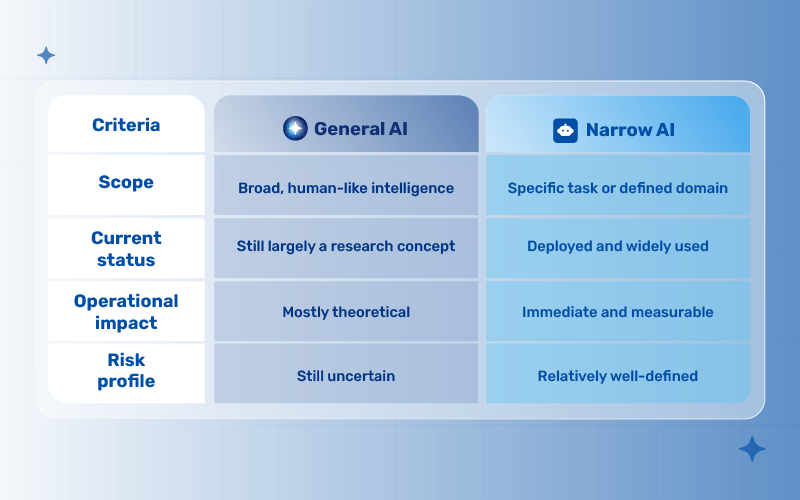
For enterprises, this distinction has a practical implication: waiting for general AI can mean overlooking operational opportunities that can already be addressed with mature, specialized AI systems.
A system that books a medical appointment, classifies a customer request, or processes a text in a regional dialect is an example of narrow AI delivering measurable value in a real-world environment.
Key Enterprise Applications of Narrow AI
The value of specialized AI applications extends beyond digital assistants. When connected to enterprise data and internal systems, AI can support employees, automate repetitive work, and turn information into faster, more accurate actions.
Natural Language Processing and Customer Service
An AI agent can understand customer inquiries, classify their intent, route requests to the appropriate workflow, and complete certain actions without human intervention.
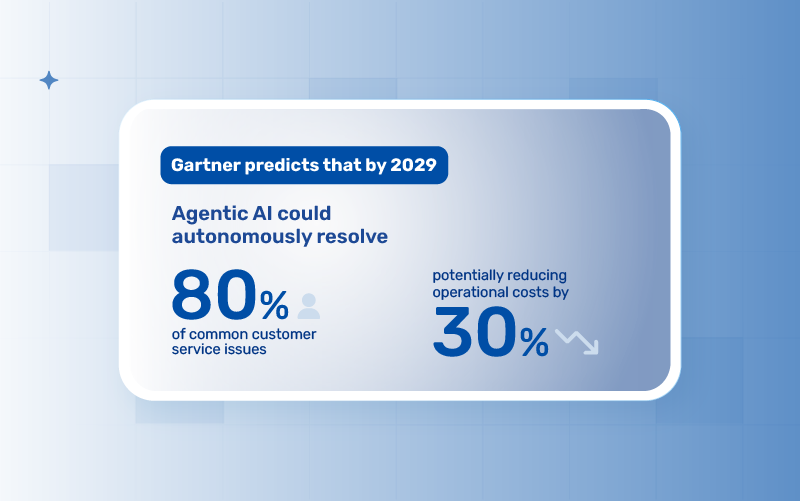
In Arabic-speaking markets, language and context add another layer of complexity. An effective system must understand dialects, intent, and differences in how customers express the same need across markets; not simply translate their words.
Common applications include:
- Answering frequently asked questions.
- Classifying and routing customer requests.
- Following up on requests and complaints.
- Providing support across multiple channels.
For example, the WhatsApp Business API can connect automated conversations with customer service workflows, helping enterprises manage interactions at scale while delivering faster responses.
Automating Repetitive Tasks
Automation of repetitive tasks is one of the clearest enterprise use cases for narrow AI, particularly when teams spend significant time on processes that require limited human judgment.
Examples include:
- Processing documents and extracting information.
- Scheduling appointments and sending reminders.
- Updating records and databases.
- Classifying requests and routing them to relevant departments.
By automating these activities, employees can spend more time on work that requires analysis, judgment, problem-solving, and human communication.
Data Analysis and Prediction
AI systems can analyze large volumes of data and identify patterns that may be difficult to detect manually. This can help management, marketing, and operations teams make more informed, data-driven decisions.
Applications include:
- Analyzing customer behavior and anticipating needs.
- Monitoring operational performance.
- Identifying growth opportunities.
- Supporting demand and sales forecasting.
- Detecting unusual patterns or cases
In marketing, these capabilities can help organizations understand audience behavior, analyze campaign performance, and turn data into actionable insights. Enterprise AI solutions for marketing can also automate parts of the marketing workflow while improving decision-making.

Why Is Narrow AI Reaching Its Limits in Modern Enterprises?
- Multiple specialized AI tools can create fragmented operations, with siloed data, delayed decisions, and disconnected workflows.
- The next generation of enterprise AI solutions goes beyond individual tasks to understand context and execute across systems.
- Leading organizations are moving toward an operational intelligence layer that can understand language, interpret context, take action, and learn from interactions.
- In Arabic-speaking markets, this requires an AI solutions provider that treats Arabic as a native capability, not simply a translation layer.
How Can Your Enterprise Start Adopting Specialized AI Solutions?
The right starting point is not choosing a technology. It is identifying the business problem worth solving first.
Look for processes that consume significant time, occur frequently, or directly affect customer experience and operational costs. Then follow a focused implementation approach:
- Identify one clear, measurable use case.
- Define the data and systems the solution requires.
- Select the appropriate model or AI agent for the task.
- Establish KPIs to measure business impact.
- Start with a limited deployment and expand based on results.
Starting with one focused use case helps enterprises reduce risk, demonstrate value, and build internal confidence before moving to more complex applications.

Conclusion
AI is no longer simply a future concept for enterprises. Specialized AI technologies can already address clearly defined operational challenges and deliver measurable business value.
The opportunity is not to accumulate more AI tools, but to build a more intelligent operating environment; one that helps organizations work more efficiently, make better decisions, and scale with confidence.
For enterprises, the path forward starts with the right use case, measurable outcomes, and a gradual connection between AI capabilities and core business systems.
FAQs About Narrow AI
What is narrow AI, and how is it different from general AI?
Narrow AI is an AI system designed to specialize in one task or a defined area, such as language understanding, data classification, or process automation. General AI aims to replicate broad human-like cognitive abilities and remains largely a research concept.
Is narrow AI suitable for large enterprises?
Yes. Narrow AI is currently one of the most practical approaches for large enterprises because specialized systems can deliver measurable outcomes, integrate with existing processes, and address clearly defined business needs.
What are the main applications of narrow AI in business?
Common applications include AI customer service agents, request classification, repetitive task automation, document processing, data analysis, forecasting, and natural language processing.
How does narrow AI support digital transformation?
Narrow AI allows enterprises to automate specific points within their digital transformation journey rather than attempting to change every process at once. This can reduce implementation risk and accelerate measurable results.
Why does narrow AI need additional language specialization in Arabic markets?
Arabic-speaking markets involve significant linguistic and contextual variation across dialects and communication styles. Effective AI therefore needs to understand Arabic language and context natively rather than simply translating content.




.webp)
.webp)
.webp)
