
.webp)
Artificial intelligence is not a single technology or capability. It spans a wide range of models and systems that differ in how they operate, what they can do, and where they are applied.
The types of AI can be classified in several ways. One common approach looks at capability, distinguishing between narrow AI, artificial general intelligence, and artificial superintelligence. Another focuses on functionality and practical use, including predictive, generative, conversational, and agentic AI.
In this guide, we break down the main AI categories, how they differ, and which types are already being used across businesses and enterprise AI company environments today.
What Are the Main Types of AI?
There is no single way to classify artificial intelligence. One of the most established frameworks categorizes AI by capability, or how broadly a system can learn, reason, and apply its abilities across different tasks.
Under this framework, there are three main types: Artificial Narrow Intelligence (ANI), Artificial General Intelligence (AGI), and Artificial Superintelligence (ASI). Narrow AI describes the systems in use today, while AGI and ASI remain theoretical concepts rather than established technological capabilities.
Types of AI by Capability
1. Narrow AI (ANI)
Artificial Narrow Intelligence (ANI), also known as Narrow AI or Weak AI, refers to systems designed to perform a specific task or operate within a defined range of capabilities.
These systems can process large volumes of data, identify patterns, understand language, analyze images, make predictions, and support decision-making. What makes them “narrow” is not necessarily their level of sophistication, but the boundaries of what they are designed and trained to do.
Most AI applications used today fall within this category, including systems powered by machine learning, natural language processing (NLP), computer vision, speech recognition, and generative AI.
Examples of Narrow AI
Common examples include:
- Recommendation engines that personalize products or content.
- Computer vision systems that recognize objects and images.
- Speech recognition and voice assistants.
- Document processing and data extraction tools.
- Predictive models used for demand forecasting or risk analysis.
- AI solutions for customer service systems that interpret requests and handle defined tasks.
Importantly, narrow does not mean simple. An enterprise AI system may operate within a specific domain while combining language understanding, knowledge retrieval, reasoning, and system integrations to process large volumes of complex workflows.
Looking to put AI into action?
See how Widebot can support your use cases and integrate AI with your existing systems.
2. Artificial General Intelligence (AGI)
Artificial General Intelligence (AGI) describes a hypothetical form of AI capable of learning, reasoning, and applying knowledge across a broad range of tasks and domains rather than being limited to a predefined area.
Often associated with the term Strong AI, AGI would be able to transfer knowledge between contexts, adapt to unfamiliar problems, and learn new skills with a level of flexibility closer to general human intelligence.
Have We Reached AGI?
There is currently no universally accepted definition or test for AGI, which makes claims about reaching it difficult to verify. Although advanced AI models can now work across language, images, audio, coding, reasoning, and other tasks, broad capability alone does not establish that a system has achieved general intelligence.
This is the key distinction between Narrow AI and AGI: narrow systems can be highly capable across the tasks and domains they were built to handle, whereas AGI implies the ability to learn and adapt across fundamentally different domains with much greater generality.
3. Artificial Superintelligence (ASI)
Artificial Superintelligence (ASI) goes a step beyond AGI. It refers to a hypothetical AI system whose intellectual capabilities would surpass human intelligence across a broad range of areas, including reasoning, problem-solving, learning, and decision-making.
Where AGI is generally framed around achieving broad, human-level intelligence, ASI describes intelligence that would exceed it.
No artificial superintelligence exists today. ASI remains a theoretical concept, primarily discussed in the context of the long-term development of AI, along with questions around safety, control, governance, and the potential implications of systems that could outperform human capabilities across many domains.
Narrow AI vs. AGI vs. ASI
The main difference between ANI, AGI, and ASI is the breadth of intelligence a system is expected to demonstrate, rather than simply how powerful or fast it is.
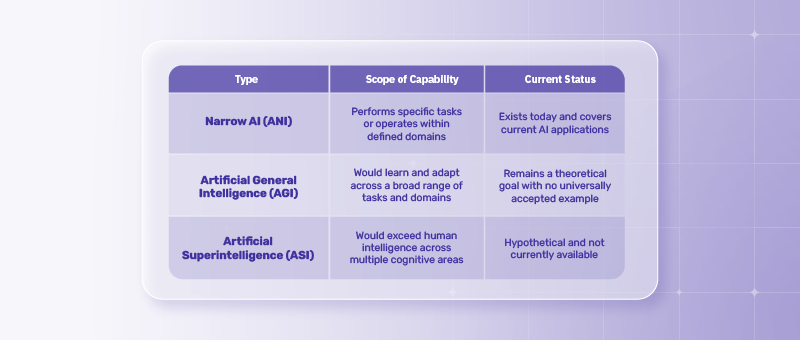
This capability-based framework is useful for understanding the broader evolution of AI, but it does not fully explain what AI systems actually do in business environments today.
For that, it is more useful to look at AI by functionality and practical application: whether a system predicts outcomes, generates content, interacts through natural language, or plans and executes tasks.
That leads to another set of categories, including predictive AI, generative AI, conversational AI, and agentic AI.
Types of AI by Functionality
AI can also be classified by how a system processes information, uses past data, and responds to its environment.
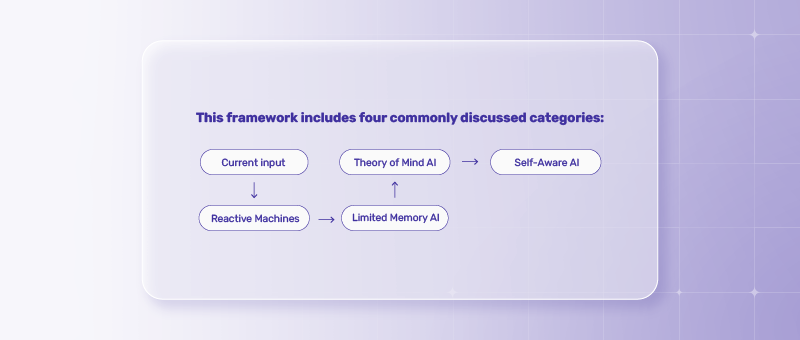
The categories move from systems that respond only to the present moment toward hypothetical systems capable of understanding human mental states and their own existence.
Unlike capability-based classifications such as ANI, AGI, and ASI, this framework focuses on how AI systems function, rather than how broadly intelligent they are.
Important note: The first two categories describe AI systems that exist today. Theory of mind AI and self-aware AI remain largely theoretical.
1. Reactive Machines
Reactive machines are the most basic form of AI in this classification.
They follow a simple pattern:
Current input → Analysis → Immediate response
These systems do not store past experiences or use them to inform future decisions. They evaluate the information available at the present moment and select a response based on predefined rules or learned patterns.
A well-known historical example is AI designed for strategy games. The system analyzes the current state of play and chooses its next move without relying on long-term memory.
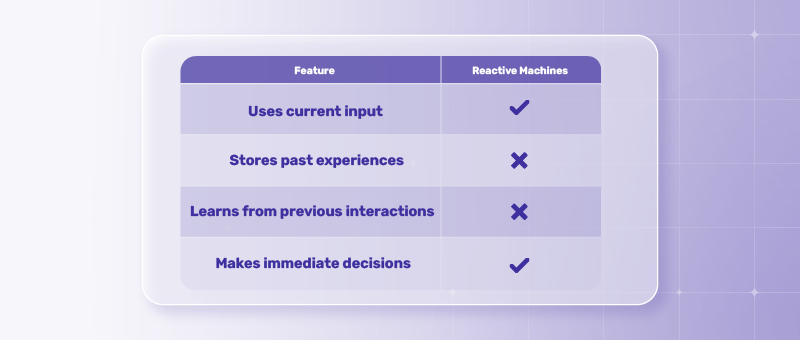
Simple example:
A chess system that evaluates the current board and selects the strongest available move without remembering previous games.
2. Limited Memory AI
Limited memory AI can use past or recently available information to support predictions and decisions.
Its process can be represented as:
Current input + Relevant past data → Prediction or decision
Many modern AI applications use some form of historical data or contextual information. Recommendation engines, predictive models, autonomous systems, and language-based applications may all rely on previous data to improve how they interpret a situation or determine the next action.
“Limited memory” does not mean human-like memory. It refers to the ability to use relevant past information within a defined context, timeframe, or system architecture.
Common examples
- Recommendation systems using previous user activity
- Fraud detection models analyzing transaction history
- Autonomous vehicles interpreting recent movement and road conditions
- Language applications using conversation context
- Predictive maintenance systems using equipment performance data
Key distinction
Limited memory AI can use relevant past information, but it does not necessarily understand that information as a human would. Its memory is usually structured, limited, and designed for a specific task.
3. Theory of Mind AI
Theory of mind AI refers to a more advanced, largely theoretical stage in which an AI system would be able to understand human mental states such as intentions, beliefs, emotions, and expectations.
This concept goes beyond identifying keywords or detecting sentiment. A true theory-of-mind system would need to understand:
What a person says + What the person believes + What the person intends + How the situation may influence their behavior
For example, such a system might recognize that a person’s words do not fully express their intention, or that two people may interpret the same situation differently based on their beliefs and experiences.
Advances in natural language processing, sentiment analysis, emotion recognition, and multimodal AI have improved how systems interpret human communication. However, today’s AI does not fully demonstrate human-level theory-of-mind understanding.
Current status
Sentiment detection ✓ Available in limited forms
Emotion recognition ✓ Available in limited forms
Context interpretation ✓ Improving
Deep understanding of beliefs and intentions ✗ Not fully achieved
4. Self-Aware AI
Self-aware AI is the most hypothetical category in this framework.
It describes a system that would not only understand its environment, but also possess awareness of:
- Its own internal state
- Its existence
- Its capabilities and limitations
- Its relationship with the surrounding environment
- Potentially, its own thoughts or experiences
The concept can be summarized as:
Understanding the environment + Understanding other people + Understanding itself
No self-aware AI exists today. The idea remains largely theoretical and is more closely associated with scientific and philosophical discussions about intelligence, consciousness, and the future of AI.
Comparing the Four Categories
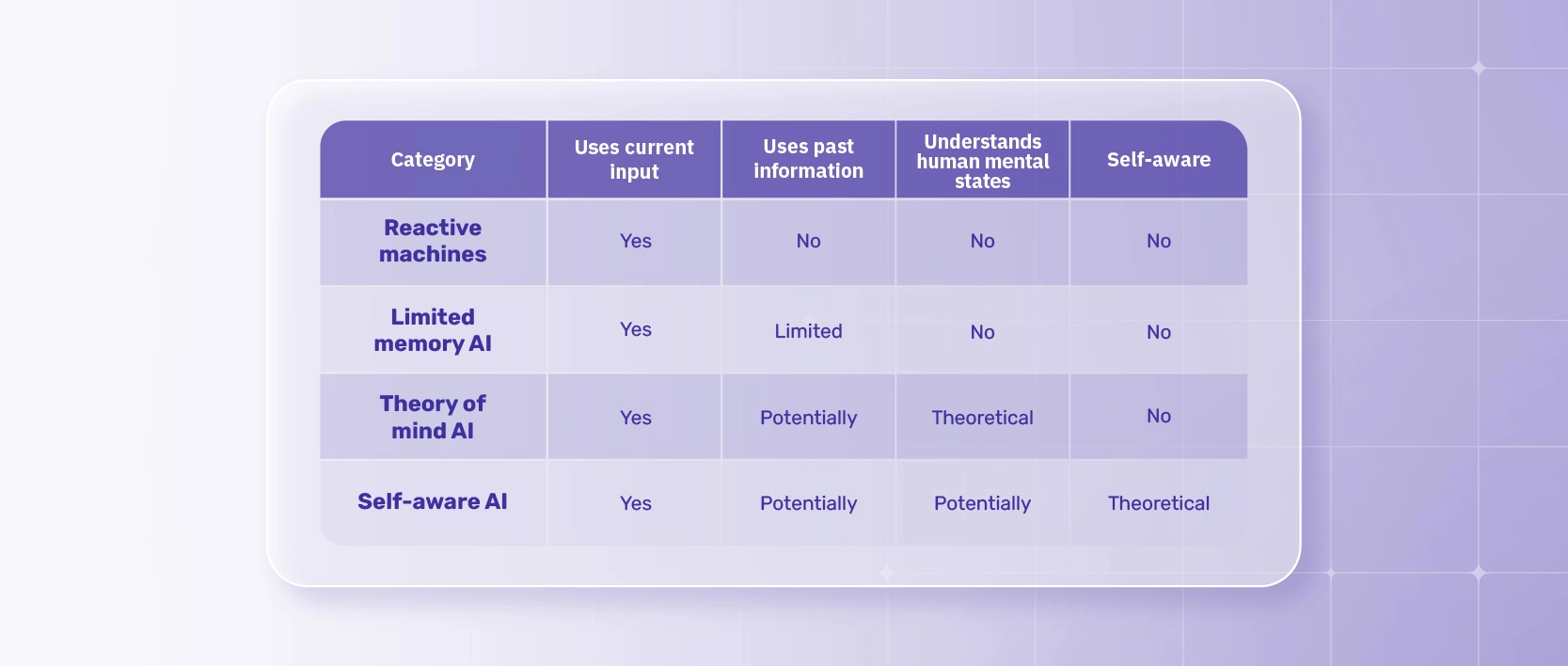
These four categories help explain different levels of information processing and interaction, from systems that simply react to current inputs to hypothetical forms of AI with far more advanced awareness.
For businesses, however, a more practical question is often:
What can the AI system actually do?
That brings us to the AI categories used in real-world applications today, including predictive, generative, conversational, voice, document, and agentic AI.
What Types of AI Are Used Today?
The classifications above explain AI by capability and functionality. In practice, businesses usually ask a more practical question:
What can AI actually help us do?
Today’s enterprise AI systems can predict outcomes, generate content, understand conversations, process documents, analyze images, and complete tasks across connected systems. Many real-world solutions combine several of these capabilities in one workflow.
Predictive AI
Predictive AI uses historical data and machine learning to estimate what is likely to happen next.
Think of it as answering:
“Based on what happened before, what is most likely to happen now?”
Businesses use predictive AI for:
- Demand and sales forecasting
- Credit and financial risk assessment
- Fraud detection
- Customer churn prediction
- Predictive maintenance
- Resource and capacity planning
Predictive AI does not guarantee an outcome. It produces probabilities based on available data, so the quality, relevance, and completeness of that data directly affect the reliability of its predictions.
Generative AI
Generative AI creates new content based on patterns learned from large datasets. It can generate:
- Text
- Images
- Audio
- Video
- Software code
Large language models (LLMs) power many text-based generative AI applications, including summarization, question answering, content drafting, information extraction, and natural-language interaction.
A simple way to think about it is:
Predictive AI estimates what may happen. Generative AI creates something new.
In enterprise environments, generative AI can help employees search and summarize information, draft communications, analyze documents, and interact with organizational knowledge more naturally.
However, generating an answer is not the same as knowing an organization’s latest policies or taking action inside its systems. Capabilities such as RAG, system integrations, and AI agents can extend generative AI beyond content creation.
Conversational AI
Conversational AI enables people to interact with technology through natural language, using text or voice.
Instead of navigating complex menus or searching through multiple pages, users can simply ask for what they need:
“How do I renew my license?”
“Where is my order?”
“Can I update my appointment?”
These systems often combine natural language processing (NLP), intent and context understanding, language models, and knowledge retrieval to interpret a request and respond appropriately.
Common enterprise applications include:
- Customer support
- Digital government services
- Banking and insurance assistance
- Employee support
- Guided service journeys
For Arabic-speaking markets, effective conversational AI must account for more than Modern Standard Arabic. It may also need to understand dialects, regional vocabulary, context, code-switching, and industry-specific terminology.
Modern conversational AI can go beyond answering questions by connecting to enterprise knowledge and operational systems, allowing it to support users throughout a complete service journey.
Voice AI
Voice AI allows systems to understand spoken language and respond through natural speech.
A typical voice AI workflow combines:
Speech-to-text (STT) → Language understanding → Reasoning or knowledge retrieval → Text-to-speech (TTS)
In enterprise settings, voice AI can help:
- Automate customer service calls
- Handle bookings and reservations
- Check service or order status
- Route conversations intelligently
- Complete selected transactions
Unlike traditional IVR systems built around rigid menus and keypad selections, modern voice AI agents can interpret natural language and respond based on the context of the conversation.
For example, a caller might say:
“I need to change my appointment to next Thursday afternoon.”
Instead of asking the caller to select several menu options, a voice AI system can understand the request, check availability, and guide the caller through the next step.
Computer Vision
Computer vision enables AI systems to interpret information from images and video.
It can help answer questions such as:
“What is in this image?”
“Is anything unusual happening?”
“Does this product meet the required standard?”
Using machine learning and deep learning models, computer vision systems can:
- Detect objects
- Recognize visual patterns
- Inspect products
- Analyze medical images
- Monitor video feeds
- Extract information from scanned documents
Its value often comes from what happens after the analysis. Visual information can trigger another workflow, support a decision, or feed data into a connected enterprise system.
Document AI
Organizations hold large volumes of information in contracts, forms, invoices, reports, and scanned records. Document AI helps turn this content into structured, searchable, and usable data.
A typical Document AI process looks like:
Upload document → Read content → Identify document type → Extract key information → Send data to the next workflow
It may combine technologies such as optical character recognition (OCR), NLP, document classification, entity extraction, and information retrieval.
For example, instead of manually reviewing every invoice, a Document AI system could identify:
- Supplier name
- Invoice number
- Date
- Total amount
- Tax information
- Payment terms
Rather than simply digitizing a document, Document AI helps organizations understand its content and make the extracted information available to other workflows or AI applications.
Agentic AI
Agentic AI moves beyond generating an answer toward helping accomplish a goal through a sequence of actions.
An agentic system can:
- Understand an objective
- Determine the steps required
- Retrieve relevant information
- Select the appropriate tools
- Interact with connected systems
- Execute actions within defined permissions
- Verify the outcome
In short:
Understand the goal → Plan → Retrieve knowledge → Select tools → Take action → Verify the outcome
Agentic AI systems may combine LLMs, RAG, AI agents, workflows, APIs, and enterprise integrations.
Consider a customer who says:
“I need to reschedule my appointment.”
A basic chatbot might explain the rescheduling policy. An agentic AI system, with the appropriate permissions, could:
- Understand the request
- Verify the customer’s information
- Check available appointment slots
- Update the booking system
- Confirm the new appointment
This is why enterprise AI decisions are rarely about choosing a single “type” of AI. The more useful question is:
Which capabilities need to work together to complete the process from request to outcome?
Conclusion: Which Type of AI Does Your Organization Need?
Understanding the different types of AI is only the starting point. For enterprises, the real question is:
What do we need AI to do, and which capabilities need to work together to make it happen?
The answer may combine predictive, generative, conversational, voice, or agentic AI with organizational knowledge, workflows, and existing systems.
The goal is not to adopt the most advanced type of AI, but to build the right combination of capabilities for the process you want to improve.
What Could AI Look Like Inside Your Organization?
WideBot AI helps enterprises and government organizations connect Arabic-first AI with their knowledge, workflows, and systems, from conversational and voice AI to RAG, AI agents, and agentic AI.
See how the right AI capabilities can work inside your organization.
Frequently Asked Questions About the Types of AI
1. What are the three main types of AI?
When classified by capability, AI is commonly divided into three categories: Artificial Narrow Intelligence (ANI), Artificial General Intelligence (AGI), and Artificial Superintelligence (ASI). Narrow AI describes systems that exist today, while AGI and ASI refer to more advanced levels of intelligence that have not been universally established in practice.
2. Is ChatGPT an AGI?
ChatGPT is not generally classified as Artificial General Intelligence. Modern AI models can perform an increasingly broad range of tasks across language, reasoning, images, and other modalities, but there is still no universally accepted test for determining when a system qualifies as AGI. OpenAI itself continues to describe its research as being on the path to AGI, defining AGI around systems capable of solving human-level problems.
3. What is the difference between Narrow AI and AGI?
Narrow AI operates within a defined set of tasks or domains. AGI, by contrast, refers to a hypothetical system capable of learning, adapting, and applying knowledge across a much broader range of unfamiliar tasks with greater generality.
4. Does Artificial Superintelligence exist?
No. Artificial Superintelligence (ASI) remains a hypothetical concept describing AI whose cognitive capabilities would exceed human intelligence across a wide range of areas.
It should not be confused with today's highly capable frontier AI systems.
5. What types of AI do businesses use?
Businesses use a combination of predictive, generative, conversational, voice, computer vision, document, and agentic AI, depending on the process they need to support.
In practice, enterprise systems often combine several technologies -such as LLMs, RAG, NLP, AI agents, and system integrations- rather than relying on one AI category in isolation.
6. What is the difference between types of AI and AI technologies?
AI types usually describe the level of capability a system has or the function it performs. Technologies such as machine learning, deep learning, NLP, LLMs, and RAG describe the methods, models, or architectures used to build those capabilities.
A single AI system may therefore combine multiple technologies to deliver one or more AI capabilities.
7. Which industries benefit from AI applications?
AI is widely used across government, banking, telecommunications, healthcare, and education. For example, AI solutions for education can improve access to information and automate selected services, while banks and government organizations use AI to enhance customer service, risk analysis, and digital journeys.




.webp)
.webp)
.webp)
