How do banks detect suspicious transactions, or AI-powered assistants understand customer requests?
The answer lies in AI algorithms, the computational methods that enable systems to process data, recognize patterns, and make predictions or decisions. Some follow predefined rules, while others learn from data to identify relationships and improve their performance.
In this guide, we explain how AI algorithms work, explore their main types, and examine practical examples of how they support intelligent systems across industries.
From AI Algorithms to Enterprise-Ready Solutions
At WideBot, we build across the AI stack, from proprietary Arabic language models to intelligent agents that integrate with enterprise systems and execute business workflows.
Explore how WideBot brings these capabilities together as an AI solutions provider.
What Are AI Algorithms?
AI algorithms are sets of computational instructions used for data processing and pattern recognition, helping systems classify information, predict outcomes, and support decisions.
An AI algorithm differs from an AI model in its function: the algorithm defines how information is processed or how learning takes place, while a trained model applies learned patterns to generate results from new data.
For example, banks can use rule-based algorithms to flag transactions that meet specific risk criteria or machine learning models to detect unusual spending patterns that may indicate fraud.
How Do AI Algorithms Work?
AI algorithms work by following predefined rules or learning patterns from data to perform specific tasks. While rule-based systems use fixed instructions, machine learning algorithms identify relationships in data to generate predictions and classify information.
Developing a machine learning model typically involves five steps:
- Data collection and preparation: Gather, clean, and organize relevant data for analysis.
- Algorithm selection: Choose an appropriate method based on the task, such as classification or forecasting.
- Model training: Train the algorithm on historical data to identify patterns and relationships.
- Testing and optimization: Evaluate the model using unseen data and refine its performance to improve accuracy.
- Deployment and monitoring: Apply the trained model to new data while tracking its performance over time.
What Are the Main Types of AI Algorithms?
Machine learning algorithms are commonly classified by how they learn from data or feedback. Three major approaches are supervised learning, unsupervised learning, and reinforcement learning.
1. Supervised Learning
Supervised learning algorithms use labeled datasets, where inputs are paired with known outcomes, to train models for classification or regression tasks. For example, banks use these models to predict the likelihood of fraudulent transactions based on historical patterns.
2. Unsupervised Learning
Unsupervised learning algorithms analyze unlabeled data to uncover hidden patterns and relationships. A common application is customer segmentation, where clustering algorithms group customers with similar purchasing behaviors.
3. Reinforcement Learning
Reinforcement learning trains systems to make sequential decisions through interactions with an environment, using rewards or penalties as feedback. It is commonly applied in robotics, autonomous systems, and simulated decision-making environments.
Another important approach is self-supervised learning, which generates training signals from the data itself and plays a central role in training modern large language models (LLMs).
6 Common AI Algorithms and Their Applications
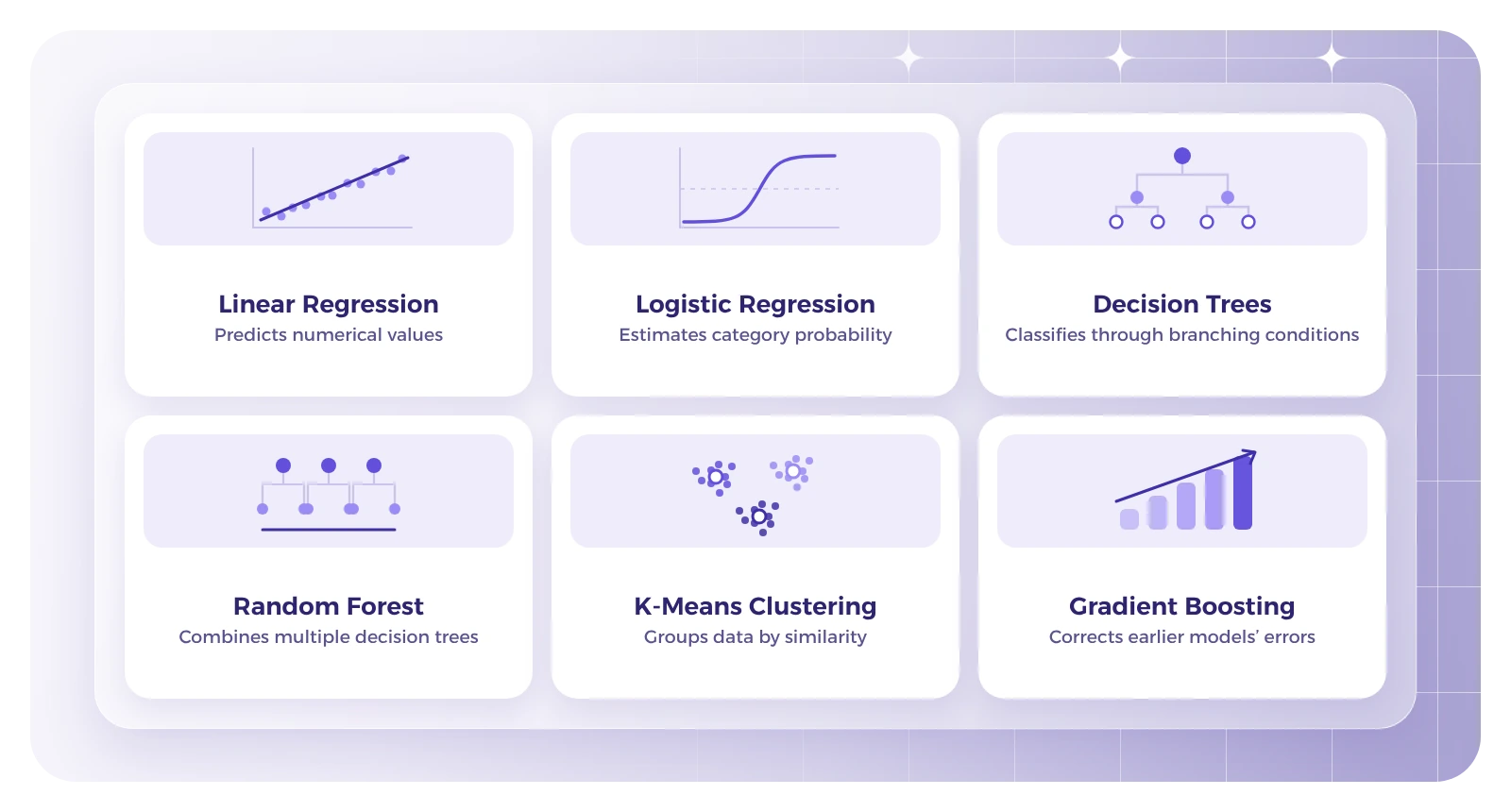
These algorithms are not limited to the examples above. Several approaches can address the same problem, but their performance may differ depending on data quality, model complexity, accuracy, and computational requirements.
When integrated with business applications, these models become part of enterprise AI systems that can route requests, trigger approved actions, and streamline service delivery.
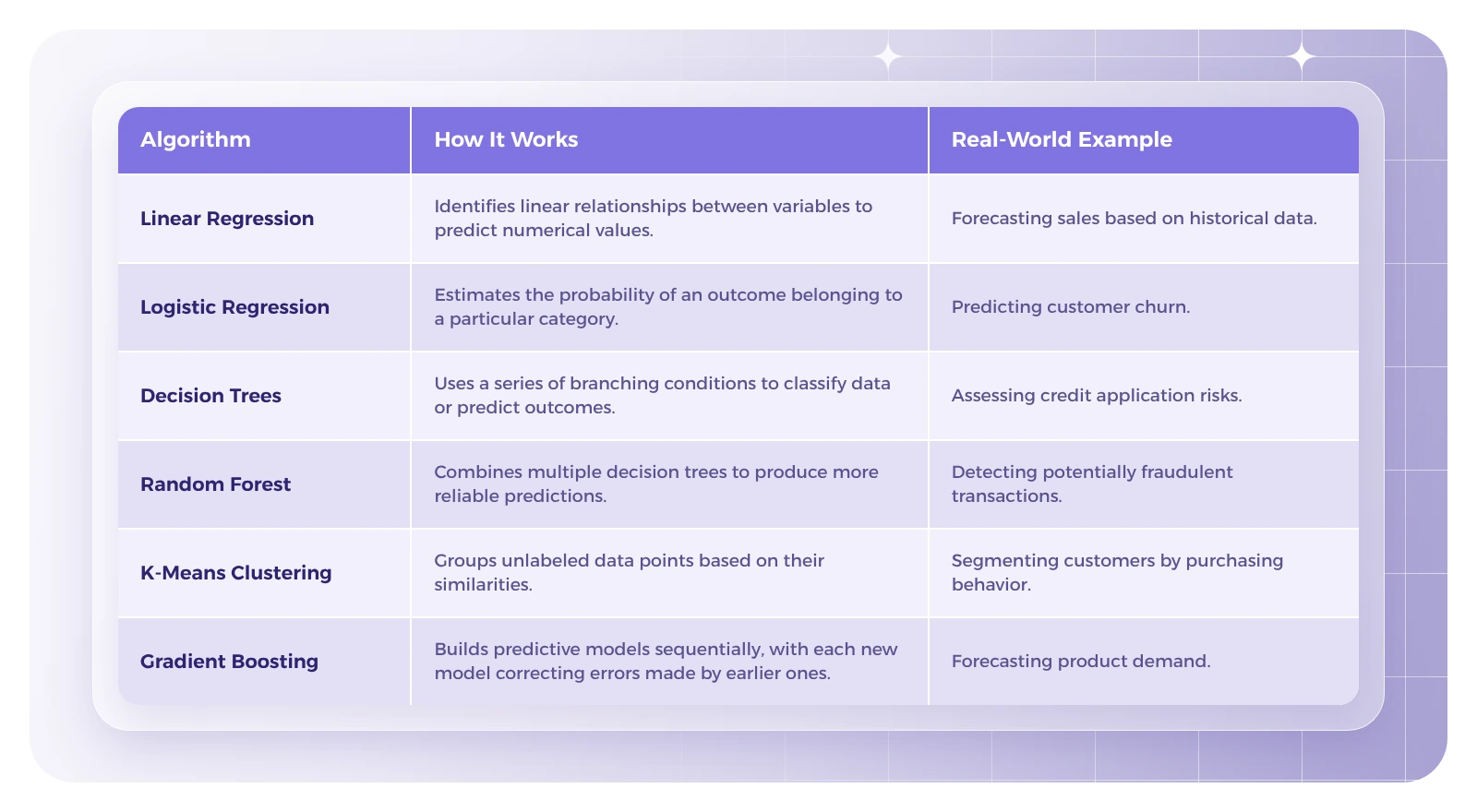
Different AI algorithms serve different purposes, from predicting numerical outcomes to classifying information and identifying hidden patterns. Here are six widely used machine learning algorithms and their practical applications:
How Do AI Algorithms Power Modern Language Models?
From Neural Networks to Large Language Models
Modern language models rely on deep learning and neural networks for natural language processing (NLP). The Transformer architecture uses attention mechanisms to capture relationships across text, enabling models to process language and generate coherent responses.
These technologies underpin modern large language models (LLMs), including an Enterprise LLM designed to support language-intensive business applications.
How Do Language Models Power AI Applications?
While language models process and generate text, AI applications turn these capabilities into practical services.
For example, a Chatbot can answer customer inquiries, while an AI agent can use language models, external tools, and enterprise integrations to execute multi-step workflows.
An AI agent is therefore an integrated system that combines different technologies, rather than a standalone machine learning algorithm.
Real-World Applications of AI Algorithms in Business
From predictive analytics to classification and clustering, different machine learning algorithms serve different purposes, including forecasting numerical outcomes and identifying hidden patterns.
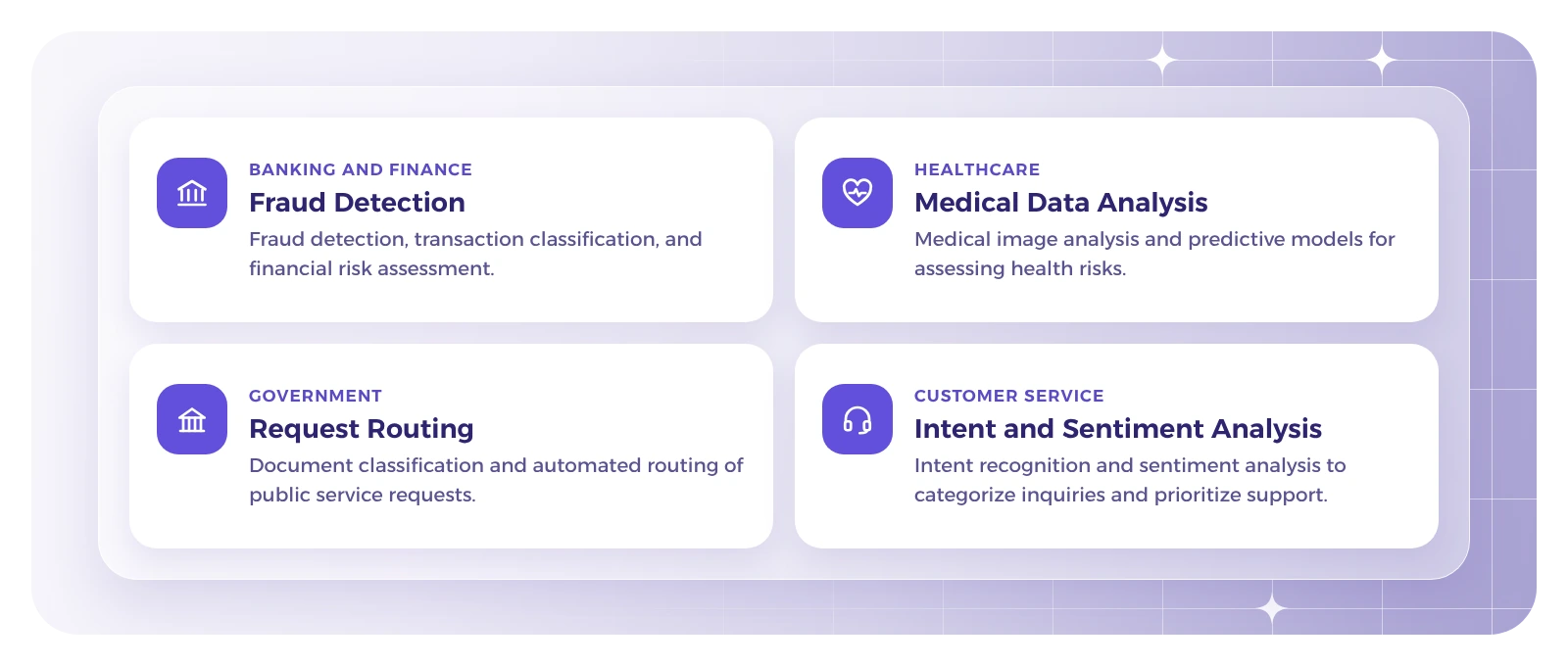
For example, when a banking customer disputes a transaction, an intent classification model can identify the request and help route it to the appropriate service workflow or human agent.
By integrating these models with enterprise systems, organizations can move beyond data analysis to automate routine tasks and streamline service delivery.
How to Choose the Right AI Algorithm
Choosing the right AI algorithm depends on the problem you're solving, the available data, and your organization's operational requirements. Four factors can help guide the decision:
- Task requirements: Are you classifying data, predicting outcomes, identifying patterns, or generating content?
- Data quality: Do you have sufficient, reliable data to train and evaluate the model?
- Accuracy and explainability: How will you evaluate AI model performance on representative test data, and does your organization need to explain the model's decisions?
- Cost and scalability: Can the solution handle growing data volumes and workloads without excessive computational costs?
Ultimately, the most advanced algorithm isn't always the best choice. The right approach balances model performance, data requirements, and operational efficiency.
Conclusion
Understanding AI algorithms is the first step toward selecting technologies that address real business needs. Their value grows when organizations integrate trained models with enterprise systems to automate workflows, improve decision-making, and deliver measurable operational outcomes.
Turn AI Capabilities into Operational Results
Choosing the right AI model is only the beginning. Discover how WideBot connects AI models and intelligent agents with your enterprise systems to automate workflows and execute complex, multi-step tasks.
FAQs About AI Algorithms
What Is the Difference Between AI Algorithms and Machine Learning Algorithms?
AI algorithms include rule-based methods and learning-based techniques used to perform intelligent tasks. Machine learning algorithms are a subset of AI that train models to recognize patterns, make predictions, and improve performance using data.
Is ChatGPT an AI Algorithm?
No. ChatGPT is an AI application powered by large language models (LLMs) trained using deep learning techniques. It combines multiple technologies rather than relying on a single algorithm.
Do All AI Applications Use the Same Algorithms?
No. Different applications require different algorithms, models, and architectures. Fraud detection, natural language processing, and text generation involve distinct computational approaches, and a single AI system may combine several techniques.
What Are the Most Common AI Algorithms?
Common AI algorithms include linear regression, logistic regression, decision trees, random forests, K-means clustering, and gradient boosting. Each serves different purposes, such as predicting numerical values, classifying data, or identifying patterns.
Which AI Algorithm Is Best for Business Applications?
There is no single best AI algorithm for every business application. The right choice depends on the task, data quality, accuracy requirements, explainability, and computational costs. Organizations should evaluate different approaches based on their specific operational needs.