AI can already outperform human experts in certain tasks. But could it eventually surpass human intelligence across nearly every field?
Super AI, or Artificial Superintelligence (ASI), represents this hypothetical frontier: AI systems capable of exceeding human cognitive abilities in reasoning, learning, creativity, and complex problem-solving.
Despite rapid advances across different types of AI, superintelligence remains a theoretical concept, fundamentally different from the AI technologies businesses use today.
So, how close are we to achieving Super AI, and how does it differ from Artificial General Intelligence (AGI)? This article explores its potential capabilities, development pathways, benefits, risks, and implications for the future of enterprise AI.
What Is Super AI (Artificial Superintelligence)?
ASI, also known as Artificial Superintelligence (ASI), is a hypothetical form of artificial intelligence that would surpass even the most capable human experts across virtually every cognitive domain, including reasoning, learning, creativity, and complex decision-making.
Unlike today's AI systems, which excel at specific tasks, superintelligence would theoretically be able to acquire knowledge independently, apply insights across disciplines, and solve unfamiliar problems beyond human capabilities.
The distinction goes beyond computing power or processing speed. While Artificial General Intelligence (AGI) describes the pursuit of human-level intelligence across diverse tasks, ASI represents a theoretical stage in which machines could exceed those abilities. To date, no AI system has been scientifically verified as achieving superintelligence.
Enterprise AI Is Already Moving Beyond Answers
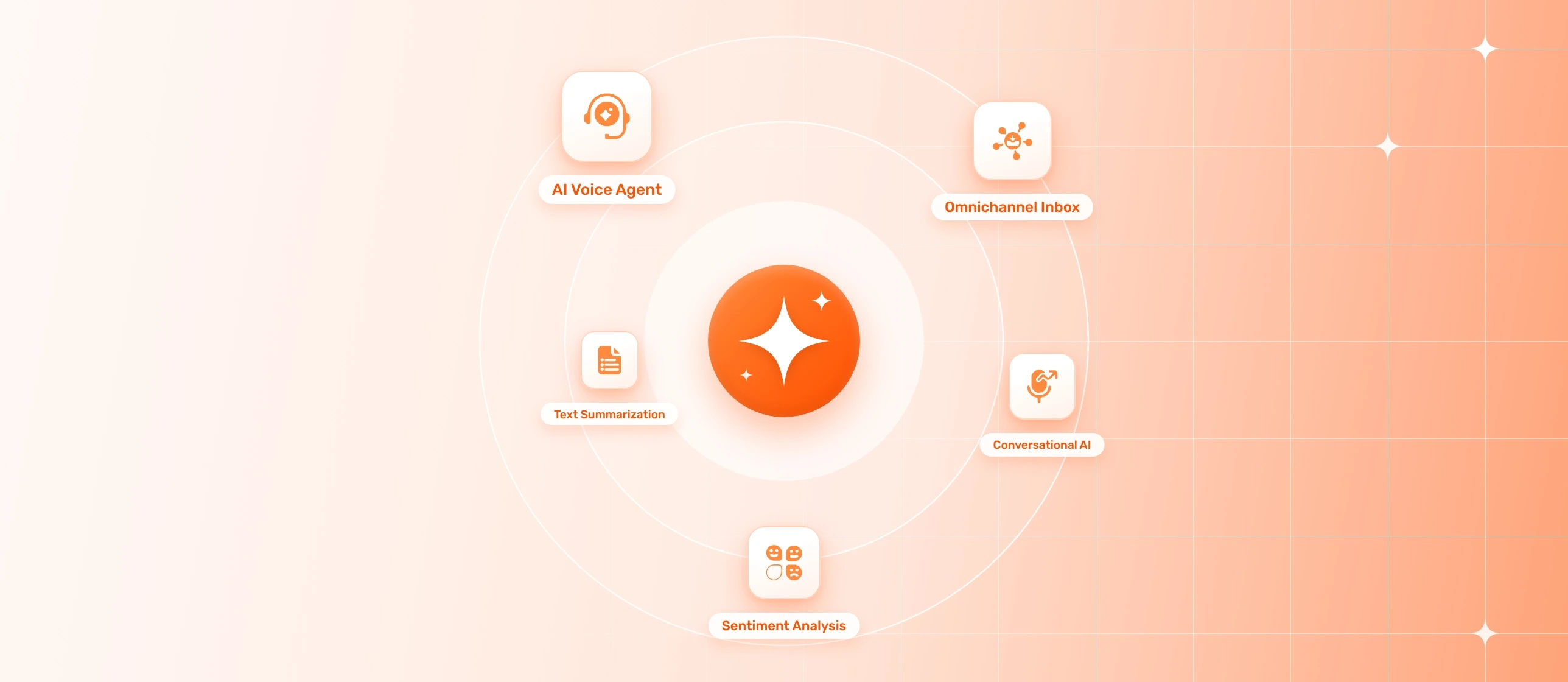
Superintelligence may still be theoretical, but enterprises can already deploy AI systems that connect organizational knowledge, automate workflows, and execute services within defined operational controls.
How Do Narrow AI, AGI, and ASI Differ?
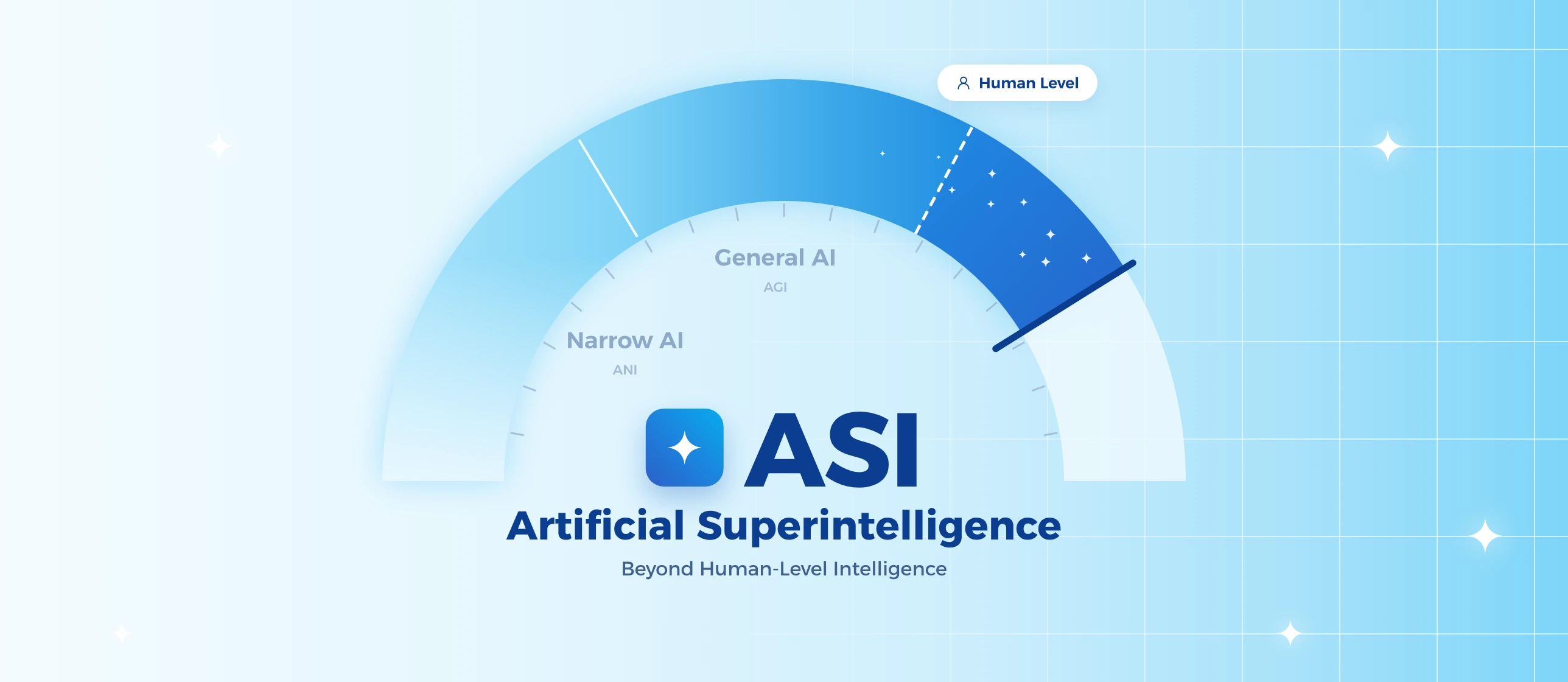
The key difference between Narrow AI, Artificial General Intelligence (AGI), and Super AI (ASI) lies in the scope of their cognitive abilities, particularly how they learn, reason, and adapt to unfamiliar challenges.
These three classifications describe distinct levels of artificial intelligence based on their capabilities, rather than a guaranteed sequence of technological development.
Artificial Narrow Intelligence (ANI)
Performs specialized tasks, such as image recognition, data analysis, and fraud detection, without demonstrating general intelligence.
Current Status:
Widely deployed today.
Artificial General Intelligence (AGI)
Would demonstrate human-level cognitive flexibility, learning, and reasoning across diverse domains.
Current Status:
Not yet established by scientific consensus
Artificial Superintelligence (ASI)
Would surpass human cognitive abilities across virtually all intellectual domains, including scientific reasoning, creativity, and problem-solving.
Current Status:
Hypothetical; not yet achieved
Modern Narrow AI systems can outperform human experts in specific areas without possessing general intelligence. Even highly capable AI models have not demonstrated the comprehensive cognitive superiority associated with superintelligence.
Understanding these distinctions is essential when evaluating different types of AI and separating proven technological capabilities from future possibilities.
What Are the Defining Characteristics of Superintelligence?
Four hypothetical capabilities could distinguish ASI (Artificial Superintelligence) from today's AI systems:
- Autonomous Learning: Acquiring knowledge and transferring skills across disciplines without task-specific retraining.
- Advanced Reasoning: Solving complex scientific and technical problems beyond human cognitive abilities.
- Scientific Innovation: Developing original theories and breakthroughs in medicine, engineering, and research.
- Recursive Self-Improvement: Refining its algorithms and learning processes to potentially achieve successive intelligence gains.
Although current AI models demonstrate elements of these abilities, none has achieved the broad cognitive superiority associated with superintelligence. Recursive self-improvement also remains an unproven pathway to ASI.
Does Super AI Exist Today?
No. As of October 2026, no AI system has been scientifically verified as achieving Artificial Superintelligence (ASI). While today's most advanced large language models (LLMs) demonstrate remarkable reasoning and problem-solving capabilities, their performance remains inconsistent across different tasks.
The Stanford AI Index Report 2026 highlights this gap. Google's Gemini Deep Think achieved a gold-medal score at the 2025 International Mathematical Olympiad. Yet on ClockBench, the best-performing AI model correctly interpreted analog clocks only 50.6% of the time, compared with 90.1% for humans.
Researchers describe this uneven performance as jagged intelligence: exceptional abilities in certain domains alongside unexpected limitations in others.
These findings reinforce an important distinction: outperforming humans on specialized benchmarks does not establish Artificial General Intelligence (AGI), let alone the broad cognitive superiority associated with ASI.
How Could Super AI Be Developed?
No proven roadmap to Artificial Superintelligence (ASI) exists. However, research highlighted by IBM and AWS explores advances in machine learning, computing power, and autonomous systems that could expand AI capabilities without guaranteeing superintelligence.
What Technologies Could Pave the Way for Artificial Superintelligence?
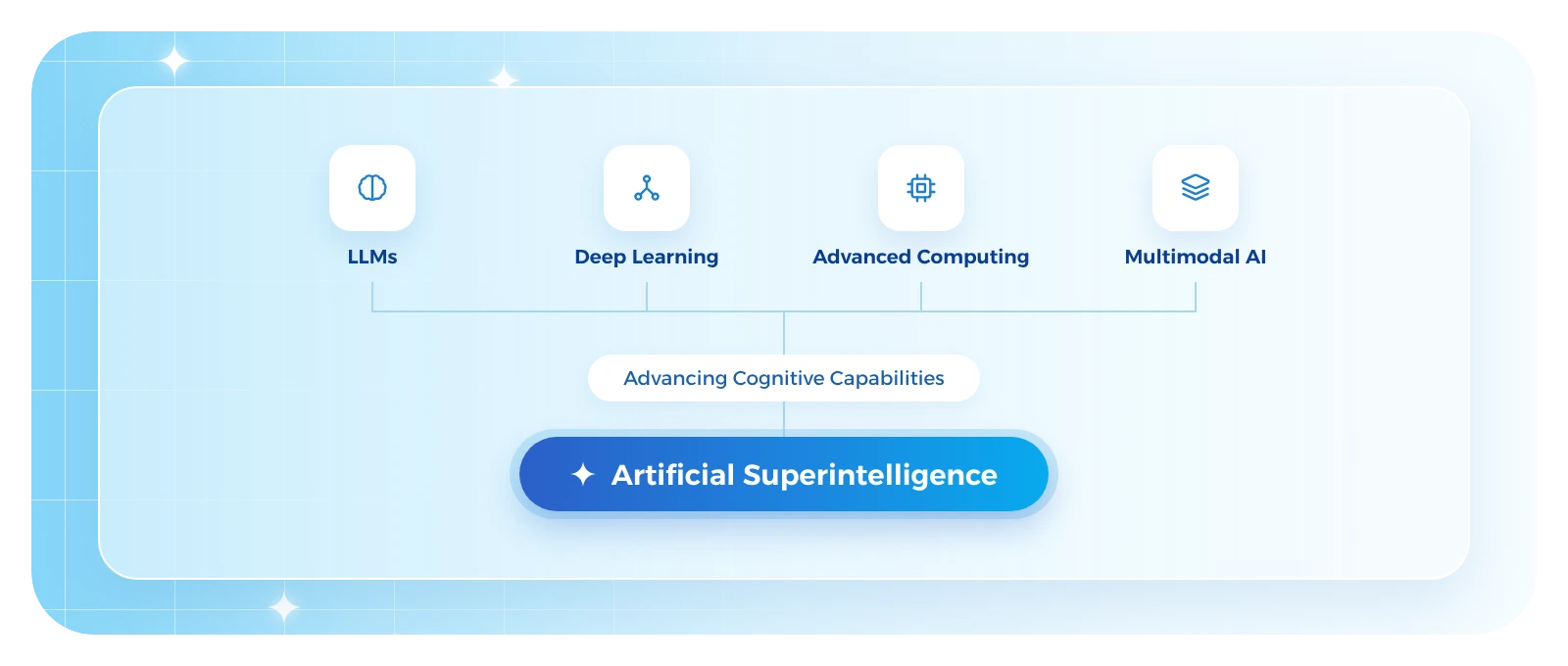
Four areas of AI research could play an important role:
- Deep Learning: Helps neural networks identify complex patterns and learn from large datasets.
- Large Language Models (LLMs): Support language processing and reasoning, despite limitations in reliability and generalization.
- Multimodal AI: Combines text, images, audio, and other data types for broader information processing.
- Advanced Computing: Provides the infrastructure for training complex models and exploring new AI architectures.
Can AI Improve Its Own Intelligence?
One proposed pathway toward superintelligence is Recursive Self-Improvement (RSI), in which an AI system enhances its own algorithms or learning processes, potentially enabling successive improvements in its capabilities.
AI already assists researchers with code optimization, algorithm development, and model testing. However, these applications differ fundamentally from open-ended, autonomous intelligence improvement.
Whether recursive self-improvement could eventually produce Artificial Superintelligence remains an open scientific question, with substantial technical and safety challenges yet to be resolved.
What Are the Potential Benefits and Applications of Super AI?
If achieved, ASI could accelerate scientific discoveries, address global challenges, and improve decision-making across complex systems.
Three areas could benefit significantly:
- Drug Discovery: Analyzing molecular interactions, identifying drug candidates, and uncovering patterns that could accelerate medical research.
- Climate and Energy: Improving climate models, optimizing energy systems, and evaluating interconnected environmental factors.
- Economic Planning: Simulating economic scenarios, anticipating risks, and supporting long-term resource allocation and strategic decisions.
What Would It Take to Realize These Benefits?
Advanced intelligence alone would not guarantee reliable outcomes. High-quality data, independently validated results, human oversight, and effective AI governance would remain critical considerations.
These applications represent potential future capabilities, not demonstrated achievements of existing AI systems.
What Are the Risks of Superintelligence, and Can Humans Control It?
The potential risks of ASI center on maintaining human control over systems that could exceed human intelligence. Four major concerns include:
- AI Alignment: Keeping system objectives consistent with human values and intentions.
- Loss of Control: Difficulty interpreting, correcting, or shutting down highly autonomous systems.
- Concentration of Power: Advanced AI capabilities becoming controlled by a few organizations or governments.
- Economic Disruption: Rapid changes to employment, resource distribution, and institutional decision-making.
How Can Enterprises Manage AI Risks Today?
While superintelligence risks remain speculative, existing AI systems already present challenges involving bias, data privacy, and unreliable outputs.
The NIST AI Risk Management Framework (AI RMF) provides a structured approach built around four functions: Govern, Map, Measure, and Manage.
Enterprises can apply these principles through access controls, systematic performance evaluations, continuous monitoring, and human oversight mechanisms.
These practices strengthen accountability and AI governance today, but they should not be mistaken for proven safeguards against future superintelligent systems.
What Does the Future of Super AI Mean for Enterprises Today?
Enterprises don't need to wait for ASI to realize the value of advanced artificial intelligence. The more immediate opportunity lies in deploying systems that connect organizational knowledge, automate complex workflows, and deliver measurable outcomes within established governance frameworks.
Is Agentic AI the Same as ASI?
No. Agentic AI and Artificial Superintelligence (ASI) are fundamentally different. Agentic AI enables systems to plan multistep tasks, interact with enterprise applications, and execute actions within defined permissions and operational boundaries.
Superintelligence, by contrast, describes a hypothetical level of cognitive ability that would surpass human intelligence across virtually all domains. Greater automation does not necessarily mean greater intelligence.
What AI Capabilities Can Enterprises Deploy Today?
Two technologies are already helping organizations move beyond AI-generated answers toward operational execution:
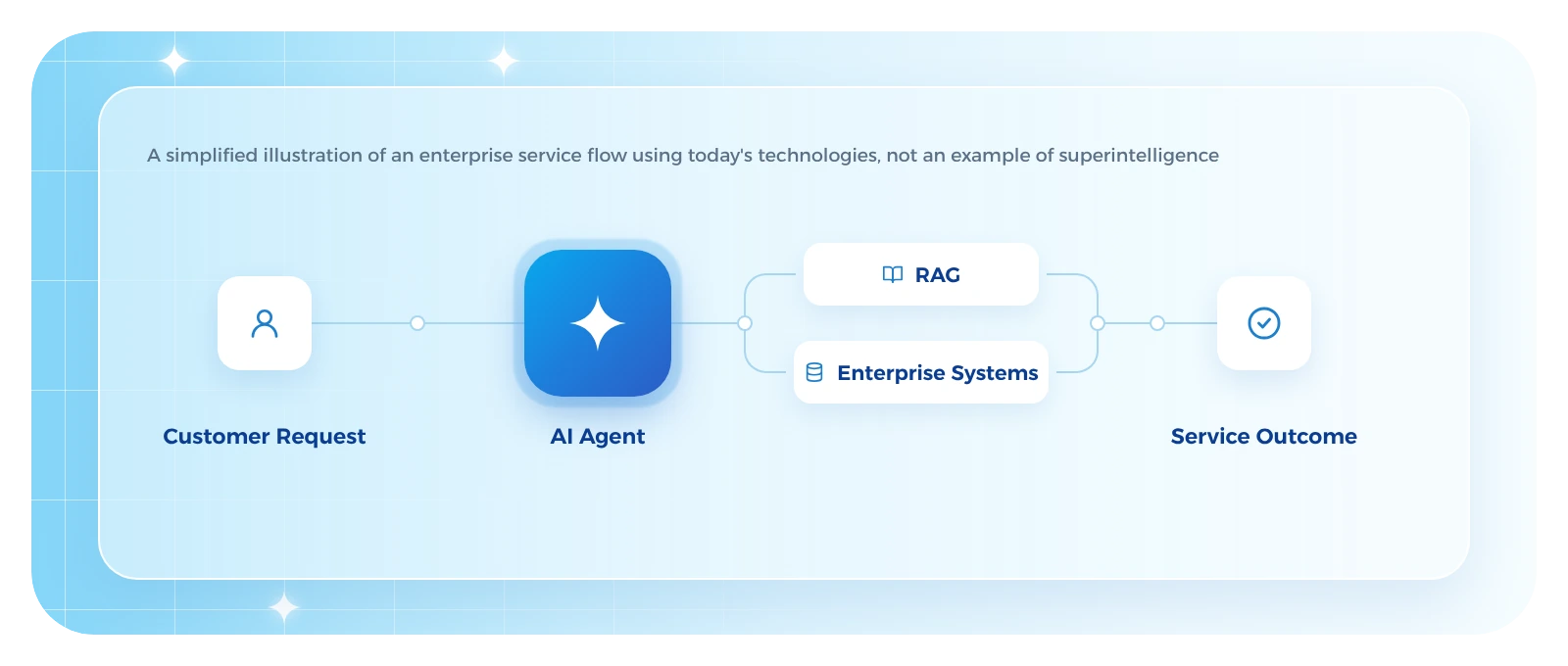
- Rag Solutions: Connects large language models to enterprise knowledge sources, including internal policies, documentation, and databases, to generate more contextually grounded responses.
- AI Agents: Integrate with business systems to retrieve information, complete authorized tasks, update request statuses, and escalate cases requiring human intervention.
What Does This Look Like in a Banking Environment?
Consider a customer checking the status of a banking application. An AI assistant could use RAG to retrieve relevant policies, while an AI Agent accesses an authorized banking system to verify the application's status and provide an update or escalate the request when necessary.
This illustrative workflow demonstrates a critical distinction: enterprise AI maturity is measured by reliability, system integration, governance, and business impact—not by how closely a technology resembles hypothetical superintelligence.
Conclusion:
ASI remains theoretical, but enterprise AI transformation is already underway. Organizations are deploying intelligent systems to connect data, automate workflows, and improve operational efficiency.
Rather than waiting for superintelligence, enterprises can invest in reliable, governed AI systems that deliver measurable business outcomes today.
Turn AI Innovation Into Measurable Business Impact
Discover how WideBot helps enterprises connect AI capabilities with business systems, streamline complex operations, and deliver smarter services at scale.
FAQ’s About Artificial Superintelligence
1. What Is the Difference Between Narrow AI, AGI, and Super AI?
Narrow AI (ANI) specializes in specific tasks, while Artificial General Intelligence (AGI) refers to systems capable of human-level reasoning and learning across diverse domains. ASI (ASI) goes further, describing a hypothetical intelligence that would surpass human cognitive abilities across virtually all intellectual fields.
2. Is ChatGPT an Example of Super AI?
No. ChatGPT is a generative AI assistant powered by large language models (LLMs). Although it can perform complex language and reasoning tasks, it has not demonstrated the comprehensive intellectual superiority required to qualify as Artificial Superintelligence.
3. Could ASI Learn and Improve Itself?
Theoretically, ASI could enhance its capabilities through Recursive Self-Improvement (RSI), repeatedly refining its algorithms and learning processes. However, whether such improvements could lead to superintelligence remains scientifically unproven.
4. When Will Super AI Become a Reality?
There is no scientifically agreed timeline for achieving Artificial Superintelligence. Its development depends on breakthroughs in AI reasoning, generalization, autonomous learning, and safety that have yet to be demonstrated at the required level.