What Is Machine Learning? How It Works, Types & Uses
What is machine learning? Machine learning (ML) is a branch of artificial intelligence (AI) that enables systems to learn from data, recognize patterns, and make predictions without being explicitly programmed for every scenario.
From detecting fraudulent transactions to predicting customer behavior, machine learning powers many of today's ai solutions. This guide explores how machine learning works, its main types, and its real-world applications, including how businesses use it to make better decisions and improve operations.
Turn AI Intelligence into Business Action
Machine learning helps organizations predict outcomes, but enterprise AI can go further by connecting intelligent models with business systems to execute complex workflows.
How Does Machine Learning Work?
Machine learning transforms historical data into predictions through four stages: data preparation, model training, evaluation, and monitoring. In banking, this predictive modeling process helps identify potentially fraudulent transactions.
- Data Processing and Preparation: The system collects historical transactions, including payment amounts, locations, and spending patterns, then cleans and organizes the data for training.
- Model Training: Using labeled examples, machine learning algorithms perform pattern recognition to distinguish legitimate transactions from potentially fraudulent ones.
- Model Evaluation: The trained model is tested on unseen data to measure its ability to detect fraud while minimizing false positives.
- Prediction and Monitoring: The model analyzes new transactions, assigns risk scores, and flags suspicious activity for review. Its performance is continuously monitored, with retraining when necessary.
The goal is to build a model that makes accurate predictions on unseen data rather than memorizing its training examples. This ability, known as generalization, is essential for evaluating how well a model performs beyond its training dataset.
What Are the Main Types of Machine Learning?
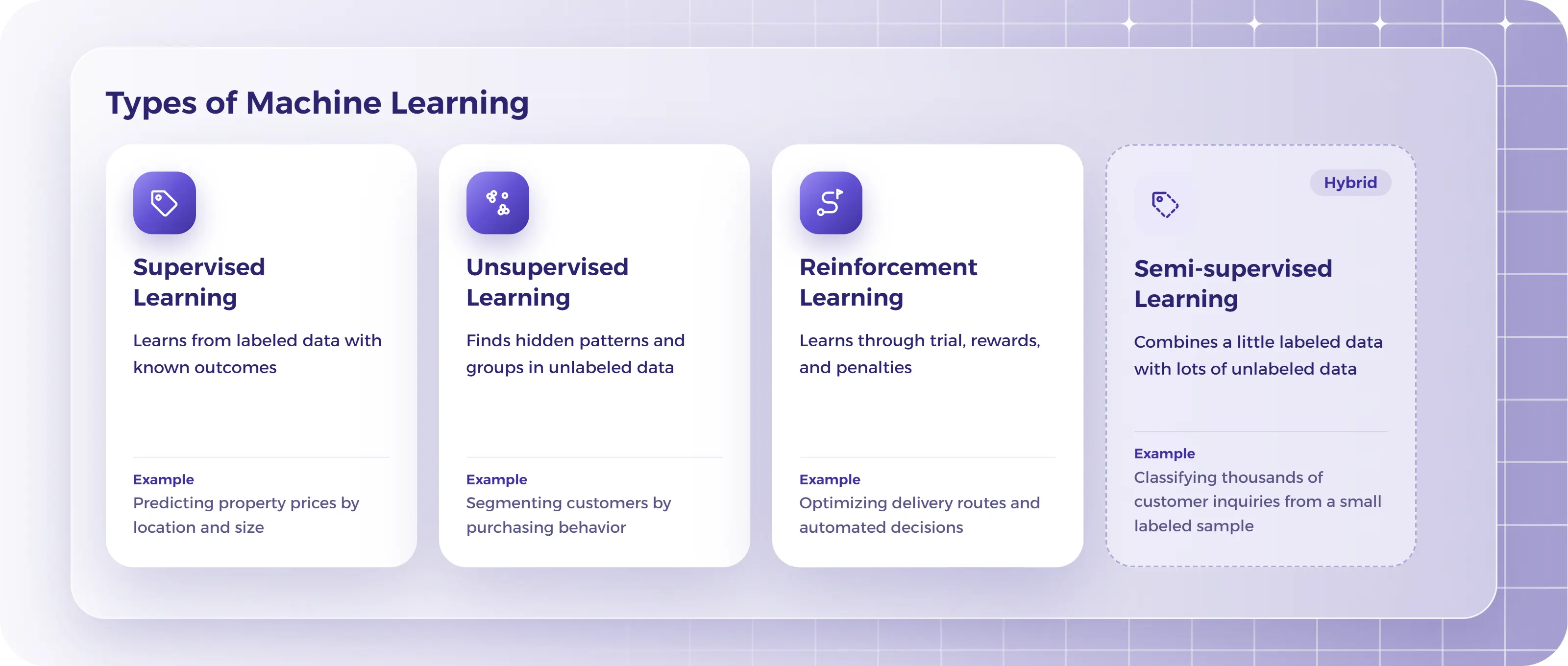
There are three main types of machine learning: supervised learning, unsupervised learning, and reinforcement learning. Each uses a different approach to learning from data and solving problems.
1. Supervised Learning
Supervised learning trains models on labeled data, where each example has a known outcome. The model learns relationships between inputs and outputs to predict results for new data. A common example is predicting property prices based on location, size, and other features.
2. Unsupervised Learning
Unsupervised learning analyzes unlabeled data to identify hidden patterns, similarities, or groups without predefined outcomes. Businesses use this approach for customer segmentation, grouping customers by purchasing behavior and preferences to deliver more personalized experiences.
3. Reinforcement Learning
Reinforcement learning enables an AI system to learn through interaction with its environment. By receiving rewards or penalties based on its actions, the system develops strategies to maximize long-term rewards. Applications include robotics, route optimization, and automated decision-making.
Another approach, semi-supervised learning, combines a small amount of labeled data with larger volumes of unlabeled data. It is particularly useful when manually labeling training data is expensive or time-consuming.
What Is the Difference Between AI, Machine Learning, and Deep Learning?

The main difference between artificial intelligence (AI), machine learning (ML), and deep learning (DL) is their scope and how they work. AI is the broadest field, machine learning is a subset of AI, and deep learning is a specialized branch of machine learning that uses multilayer neural networks to process complex data.
Here's how these technologies compare:

What Are the Real-World Applications of Machine Learning?
Machine learning powers everyday recommendation engines that suggest content based on viewing habits. In business, data analysis and predictive analytics help organizations identify risks, forecast outcomes, and improve operations.
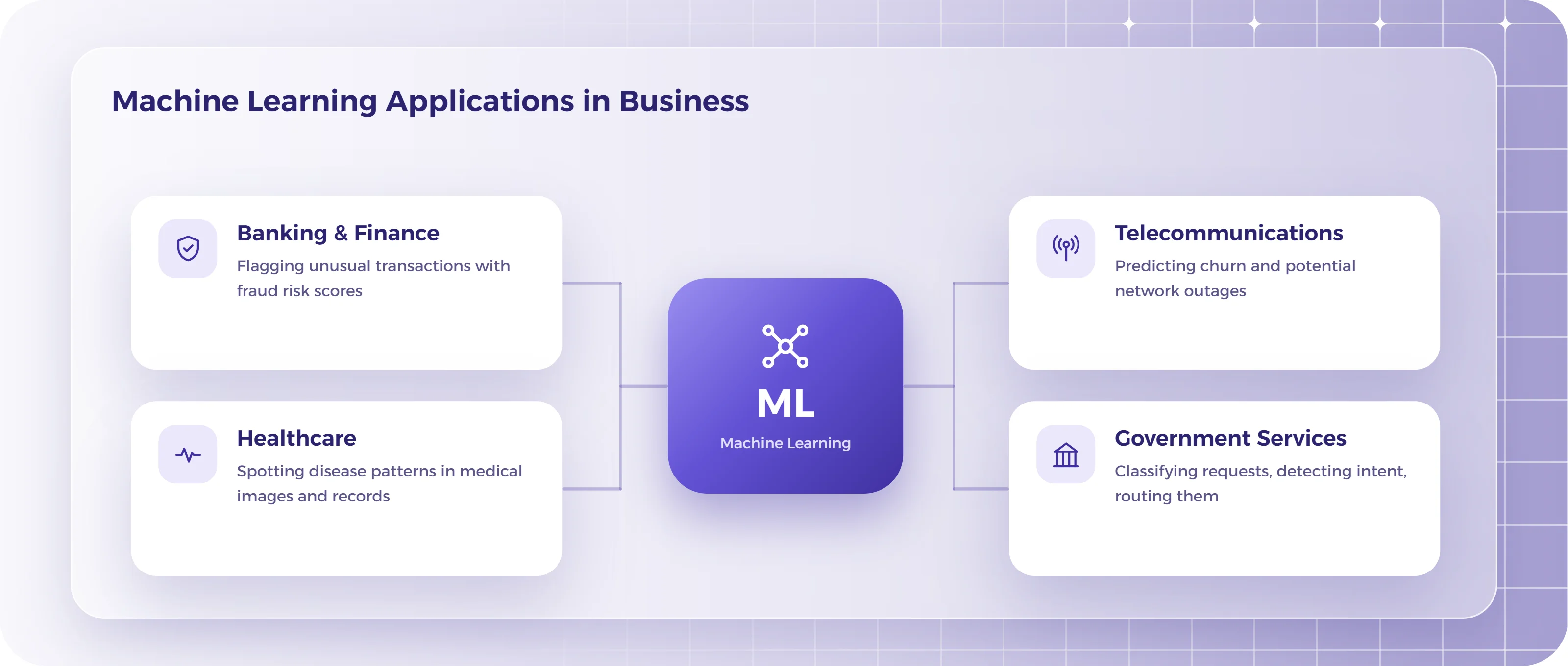
1. Fraud Detection in Banking and Finance
Financial institutions analyze transaction amounts, payment locations, and spending patterns to detect unusual activity. Machine learning models assign risk scores and flag potentially fraudulent transactions for further investigation.
2. Healthcare and Medical Data Analysis
Machine learning algorithms analyze medical images, patient records, and clinical data to identify patterns associated with diseases. These insights help healthcare professionals detect abnormalities and make more informed clinical decisions.
3. Telecommunications and Network Optimization
Customer behavior analysis helps telecom providers predict churn using service usage, complaints, and subscription history. Network performance data also helps identify potential outages and prioritize preventive maintenance.
4. Government Services and Customer Support
Government agencies and enterprises use machine learning and natural language processing (NLP) for data classification, intent detection, and automated request routing. These capabilities also support intelligent chatbot systems.
How Is Machine Learning Related to Generative AI and AI Agents?

Machine learning provides the foundation for many generative ai systems. Through deep learning, large language models (LLMs) learn patterns from training data to understand language and generate content. WideBot’s AQL models, for example, are designed to support Arabic language understanding and generation.
However, generating content is different from executing tasks. While an AI model can answer questions or create text, an enterprise ai agent can combine those capabilities with connected tools and business systems to complete workflows, such as checking order statuses, updating records, and notifying customers.
In this way, machine learning powers intelligent models, while integrated AI systems turn those capabilities into practical business operations.
What Are the Main Challenges of Machine Learning?
Despite its benefits, machine learning presents several challenges that can affect model accuracy, reliability, and business outcomes:
- Data Quality: Incomplete, inaccurate, or inconsistent training data can lead to unreliable predictions.
- Algorithmic Bias: Unrepresentative datasets may produce biased results and unfair decisions.
- Data Drift: Changes in customer behavior or operating conditions can reduce model performance over time.
- Data Privacy: Processing sensitive information requires strong security measures, access controls, and compliance with data protection requirements.
Addressing these challenges requires ongoing model monitoring, performance evaluation, and effective AI governance. The NIST AI Risk Management Framework provides guidance for managing AI risks and improving the trustworthiness of systems throughout their lifecycle.
Conclusion
Machine learning transforms data into actionable predictions that support better decision-making. As AI technologies evolve, combining predictive models with intelligent agents and integrated business systems enables enterprises to automate complex workflows, improve services, and operate more efficiently.
Turn AI Capabilities into Real Business Outcomes:
From Arabic language models to intelligent agents and enterprise integrations, WideBot provides a full-stack AI platform that helps organizations build, deploy, and scale AI-powered solutions tailored to their operations.
FAQs About Machine Learning
Does Machine Learning Require Large Amounts of Data?
Not always. The amount of training data needed depends on the task, algorithm complexity, and data quality. Some machine learning models perform well with smaller, high-quality datasets, while more complex models typically require larger datasets to achieve reliable predictions.
Does Machine Learning Automatically Improve Over Time?
Not necessarily. Most machine learning models do not learn from every new interaction. Improving their performance typically requires collecting new data, retraining, and evaluating the model. Continuous improvement is possible when systems are specifically designed for online or incremental learning.
What Is the Difference Between a Machine Learning Algorithm and a Model?
A machine learning algorithm is a method used to identify patterns in data during training, while a machine learning model is the trained system that applies those patterns to make predictions or classify new information.
How Is Machine Learning Model Performance Measured?
Model performance is evaluated using unseen test data and metrics such as accuracy, precision, recall, and F1-score. As explained in Google's classification evaluation guide, choosing the right metrics depends on the task and the consequences of incorrect predictions.