

Imagine a crowded boardroom filled with reports and files. An executive stands before the team and says:
“We need an entire week just to sort through this data and make a simple decision”
This scene plays out every day across government entities and large enterprises, where information accumulates without structure, decisions are delayed by bureaucracy, and valuable human effort is consumed by low-value processing tasks.
Today’s technology landscape does not suffer from a lack of data; it suffers from a lack of systems capable of turning data into action. Organizations have systems, but those systems often operate in isolation. Digital operations continue to expand, yet operational awareness fails to keep pace. The result is an abundance of information coupled with a shortage of effective decision-making.
This gap gave rise to Agentic AI.
At its core, Agentic AI functions as an operational representative of the organization. It:
- Understands the objective that needs to be achieved.
- Connects with operational systems and data sources.
- Collects, analyzes, and reasons over information.
- Produces a recommendation, decision, or action within the same operational cycle.
This shift goes beyond accelerating task execution; it fundamentally changes how decisions are made. The presence of intelligent agents inside the enterprise enables a transition from reactive operations to continuous proactive action, and from solving problems after they occur to preventing them before they escalate.
In government environments, such systems can reduce months of bureaucratic correspondence to minutes. In large enterprises, they ease the burden on operational teams and provide leadership with data-driven decisions without requiring lengthy meetings or extensive reporting cycles.
How Does Agentic AI Work Inside Governments and Enterprises?
Agentic AI is not simply about generating faster responses. Its value lies in its ability to think and operate much like a real employee within a team; an always-on operational agent that understands goals and acts independently across the organization's digital ecosystem.
Its workflow typically consists of four interconnected layers:
1. Intent Understanding
The agent does not require detailed instructions. It only needs to understand the objective, such as:
- “Generate the quarterly risk report.”
- “Close the complaint after escalation review.”
2. System Orchestration
The agent autonomously connects to systems such as ERP, CRM, DMS, and APIs to:
- Retrieve relevant data.
- Open or update tickets.
- Query ongoing processes and cases.
3. Contextual Reasoning
The agent analyzes information within the organization's context, incorporating:
- Governance policies.
- Permission structures.
- Escalation rules.
- Risk management frameworks.
4. Action or Decision Delivery
Based on the outcome, the agent may:
- Execute an action directly.
- Deliver a decision in an auditable format.
- Escalate the matter to leadership when required.
Why Is It Called an “Agent”?
Because Agentic AI behaves as more than a digital assistant.
It functions as an active member of the organizational structure:
- Operating within predefined permissions.
- Executing operational steps without requiring constant instructions.
- Integrating with systems and teams rather than operating outside them.
- Producing accountable outcomes, not merely language-based suggestions.
This changes the nature of work itself. Instead of teams becoming overwhelmed by growing workloads, tasks can be distributed across intelligent agents operating in parallel. Instead of reacting to problems after they emerge, organizations can proactively address them before they become critical.
Why Is Agentic AI Emerging Now and Not Five Years Ago?
The rise of Agentic AI is not an isolated technological breakthrough. It is the result of three major shifts occurring simultaneously across enterprise technology and operations.
1. The Explosion of Operational Complexity
Governments, banks, and infrastructure organizations now depend on dozens of interconnected systems.
The volume of requests, tickets, regulations, reports, and approval chains has grown to the point where human intervention has become a bottleneck.
Organizations no longer need systems that merely assist. They need digital entities capable of operating independently within increasingly complex environments.
2. The Maturity of LLMs and Enterprise RAG
Before 2023, AI models were powerful in language generation but weak in organizational context.
Today, the combination of:
- Large Language Models (LLMs)
- Retrieval-Augmented Generation (RAG)
- Enterprise Integration APIs
has created an environment where AI agents can:
- Understand natural language deeply.
- Access institutional knowledge sources.
- Make decisions based on verified information rather than linguistic prediction alone.
This technological foundation simply did not exist a few years ago.
3. The Shift from Automation to Delegated Intelligence
The last decade of digital transformation focused heavily on automating workflows:
- Robotic Process Automation (RPA)
- Workflow engines
- Rule-based software bots
However, a new question emerged:
Who decides when and why automation should occur?
The answer was not another bot.
It was an intelligent agent capable of connecting objectives, decisions, and execution.
This is where Agentic AI emerged as the next stage beyond automation.
The Bottom Line
Agentic AI exists because organizations increasingly need internal digital entities that can think and act; not tools that simply wait for human instructions.
Agentic AI vs. Traditional Chatbots: Why Chatbots Are No Longer Enough
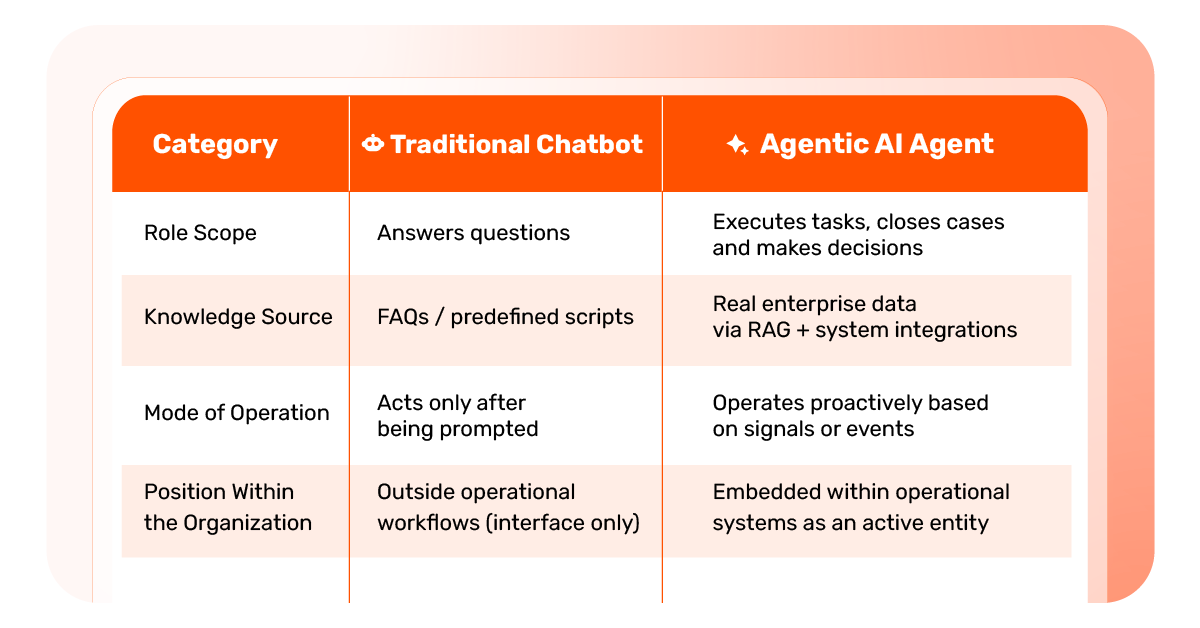
Agentic AI does not replace conversational AI; it extends far beyond it.
Traditional chatbots were designed to answer questions.
Modern organizations need systems that can work, decide, and execute actions inside enterprise environments.
A chatbot is comparable to a receptionist at the front desk.
An AI agent is comparable to an internal employee with defined permissions who can complete end-to-end processes.
Where Does WideBot Fit Into This Evolution?
The Arabic market has had chatbots since 2018.
The value is no longer in generating responses.
The value is now in executing work.
WideBot addresses this shift through three differentiated layers:
Deep Arabic Understanding
Voice and chat agents that understand Arabic beyond dialect recognition; capable of interpreting operational intent within government, banking, and enterprise environments.
Enterprise System Integration
Direct integration with:
- ERP systems
- CRM platforms
- DMS environments
- ServiceNow
- Core Banking systems
These agents can create, modify, retrieve, close, and escalate; not simply display information.
Auditable Enterprise Behavior
Every action follows institutional rules, including:
- Permission boundaries
- Escalation logic
- Risk management frameworks
- Governance policies
- Audit logs
The result is an AI agent that becomes part of the decision-making cycle rather than an external conversational layer.
Why Are Chatbots No Longer Sufficient?
Organizations no longer struggle with unanswered questions.
They struggle with unexecuted decisions and growing operational workloads.
Chatbots improved communication.
They did not create digital entities capable of acting on behalf of humans within enterprise systems.
Today's transformation is a shift:
- From conversation to delegation.
- From interface-level information to internal decision execution.
- From linguistic intelligence to operational intelligence.
The Impact of Agentic AI on Jobs, Governance, and Security
As AI evolves from answering questions to taking actions, its impact extends beyond technology into organizational structure and governance.
1. Workforce Impact: Redistribution, Not Elimination
AI agents reduce operational pressure on customer service, operations, and compliance teams.
Human roles increasingly focus on:
- Supervising agent logic.
- Managing exceptional cases.
- Driving analysis and quality improvement.
The agent handles repetitive operational work, while humans focus on judgment, accountability, and strategic decision-making.
2. Governance Impact: Decisions Become Traceable
Unlike traditional AI systems that provide answers without accountability, Agentic AI executes actions within enterprise systems.
This requires:
- Clearly defined permission boundaries.
- Escalation frameworks.
- Complete audit trails for every action and decision.
This strengthens organizational discipline and improves accountability.
3. Security Impact: Intelligence Within Controlled Boundaries
The challenge is not intelligence; it is access.
AI agents interact directly with enterprise systems such as ERP and CRM platforms.
Organizations therefore require:
- On-premises deployment or private cloud environments.
- Role-based access controls.
- Full logging of inputs, outputs, and actions.
This is where WideBot's secure deployment architecture enables enterprises to adopt AI agents while maintaining full control over sensitive data.
Real-World Agentic AI Use Cases
Agentic AI functions as an operational layer inside organizations, applying the principles of autonomy in AI and enhancing decision-making through intelligent execution.
Government Sector
AI agents can:
- Receive requests through voice, WhatsApp, or government portals.
- Connect with systems such as Oracle, ServiceNow, and SAP.
- Execute administrative workflows automatically.
- Notify citizens and employees of updates.
WideBot delivers this through Agentic Voice and Agentic Chat solutions deployed securely within government environments.
Banking and Insurance
AI agents can:
- Retrieve customer information from CRM systems.
- Assess loan applications or insurance claims.
- Approve, reject, or escalate cases according to policy.
- Update enterprise systems with full auditability.
This represents true executive AI operating within financial institutions.
Telecommunications and Customer Services
WideBot introduced one of the region's first Agentic Voice experiences through WhatsApp Business calls.
Agents can:
- Renew subscriptions.
- Open service requests.
- Connect directly to ServiceNow.
- Execute actions and send confirmations automatically.
The channel evolves from customer support to autonomous service execution.
Healthcare and Education
Use cases include:
- Appointment scheduling.
- Student enrollment and SIS integration.
- Proactive workflows powered by multi-agent systems.
What Makes WideBot Different?
WideBot delivers a complete Agentic AI infrastructure that includes:
- Arabic-native Agentic Voice and Agentic Chat.
- Direct integration with ERP, CRM, and Core Banking systems.
- Secure On-Premises and Private Cloud deployment models.
This transforms AI from an intelligent interface into a true operational agent that supports autonomy, governance, and enterprise-grade decision execution.
Why Is Agentic AI the Next Stage of Enterprise Transformation?
Organizations are no longer looking for tools that answer questions or dashboards that display data.
They need intelligence that operates from within the organization; capable of understanding, analyzing, executing, and escalating without requiring human intervention at every step.
That is the essence of Agentic AI.
It represents a shift from partial automation to true operational autonomy.
With the emergence of multi-agent systems, work can now be distributed across multiple specialized agents operating collaboratively within the same organization.
The result is better decision-making; not through recommendations alone, but through auditable actions executed directly inside enterprise systems.
WideBot represents this vision in the Arabic market through enterprise-grade voice and chat agents designed for government, banking, insurance, and large-scale enterprise environments.
Practical Conclusion
Agentic AI is not simply another wave of conversational AI.
It marks the beginning of a new era in which organizations move from manually managing operations to delegating work to autonomous operational agents.
This may be the most significant shift in enterprise AI since organizations first began adopting artificial intelligence over a decade ago.
Are You Ready to Move from Observing Intelligence to Executing Intelligence?
If this article demonstrates anything, it is that the next phase of enterprise AI will not be powered by chatbots alone.
It will be powered by digital agents capable of understanding, reasoning, and executing within enterprise systems.
WideBot delivers practical solutions that enable this transition through:
Enterprise Assistant
An enterprise-grade assistant operating as an internal AI agent across ERP and CRM environments, powered by RAG and enhanced by AQL (Arabic Quality Layer) to ensure accurate understanding of institutional Arabic context.
Voice AI Agent
A voice-based AI agent operating across phone and WhatsApp Business channels, capable of executing operational actions; not just conversations.
Omni-Channel Inbox
A unified workspace for managing interactions across WhatsApp, web, mobile applications, and voice channels, with intelligent routing between AI agents and human teams.
Operational Intelligence Layer
- RAG to ensure decisions are grounded in verified enterprise data.
- AQL Gen AI to support Arabic dialect understanding and enterprise-specific context across government and financial environments.
If your organization is ready to move beyond conversational tools toward digital entities that work on your behalf, WideBot provides a practical path to enterprise-grade Agentic AI.
Book a consultation today and move from theoretical possibilities to a real-world implementation roadmap.
FAQs about the agentic AI
1. What is Agentic AI and how does it differ from a chatbot?
Agentic AI is a system that understands objectives, connects to enterprise systems, reasons over data, and executes actions autonomously. Chatbots answer questions — Agentic AI completes work.
2. Why is Agentic AI emerging now?
Three shifts converged: operational complexity in enterprises, the maturity of LLMs and RAG, and the move from rule-based automation to delegated intelligence that can decide when and why to act.
3. How does Agentic AI integrate with enterprise systems?
Agents connect directly to ERP, CRM, DMS, ServiceNow, and Core Banking platforms; retrieving data, updating records, opening tickets, and escalating cases within governed permission boundaries.
4. Is Agentic AI safe for governments and regulated industries?
Yes, when deployed correctly. Enterprise-grade Agentic AI runs on private cloud or on-premises infrastructure with role-based access, complete audit logs, and escalation rules aligned to governance policies.
5. Will Agentic AI replace human employees
No. It redistributes work; handling repetitive operational tasks while human teams focus on supervision, exceptional cases, judgment, and strategic decision-making.




.webp)
.webp)
.webp)
