
.webp)
Governments around the world are under increasing pressure to deliver faster services, streamline internal operations, and improve citizen engagement; all while managing tighter budgets and often relying on legacy systems.
This is where AI Agents come in.
Acting as AI-powered digital employees, AI agents help governments accelerate digital transformation, reduce bureaucratic complexity, improve service delivery, and increase operational transparency.
From providing instant responses to citizen inquiries to analyzing massive datasets that inform public policy decisions, AI agents are rapidly evolving into a critical component of digital transformation strategies across the public sector.
In this article, we explore ten key benefits government organizations can achieve by adopting AI agents as part of their digital transformation journey.
Benefits of Using AI Agents in Government Organizations
As mentioned earlier, government entities can unlock significant value by deploying AI agents to improve public service delivery and optimize internal operations that serve large populations.
Below are ten of the most impactful benefits.
1. Improving Public Service Delivery Through 24/7 Availability
Today’s citizens expect immediate access to services and information.
AI agents operate around the clock, providing instant responses through government portals, WhatsApp, mobile applications, and other digital channels. This ensures that citizen inquiries never go unanswered, even during weekends, holidays, or emergency situations.
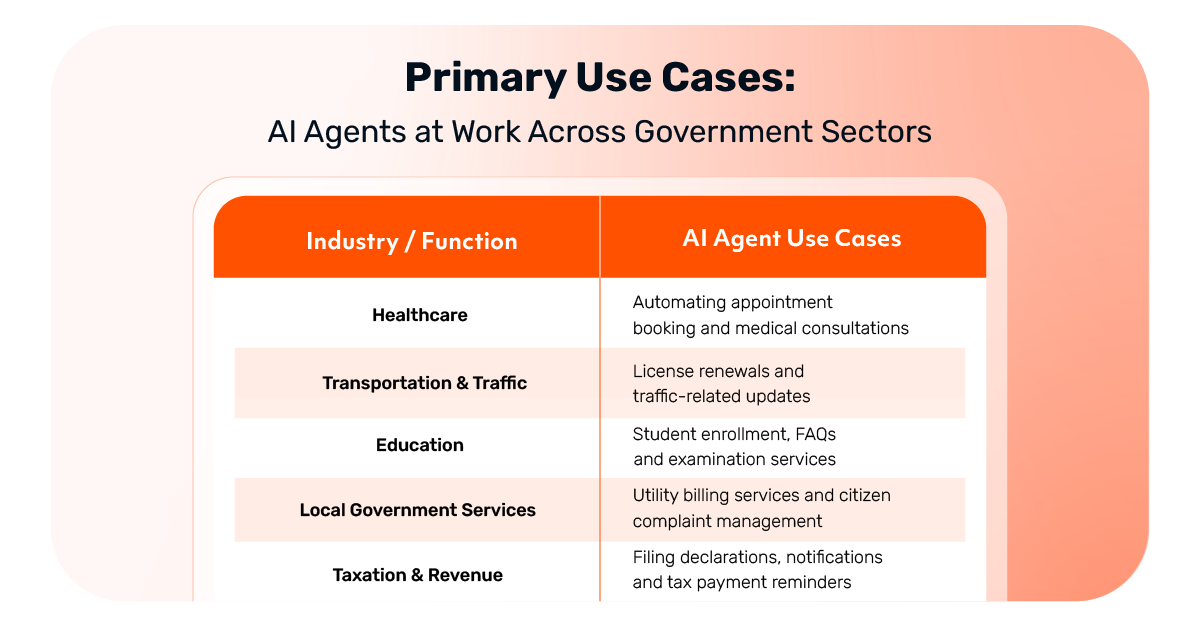
For example, AI agents can help citizens pay bills, submit complaints, schedule appointments, or access government services at any time without requiring human intervention.
2. Reducing Operational Costs and Bureaucratic Burden
Manual processes and large contact centers consume significant public resources.
AI agents reduce reliance on large customer service teams by automating thousands of daily interactions and government service workflows. This enables employees to focus on higher-value responsibilities while helping governments save millions in administrative costs annually.
3. Automating Citizen Inquiries and Case Management
Whether responding to questions such as “How do I renew my license?” or managing citizen benefit applications, AI agents can handle complex service workflows efficiently.
These systems integrate with databases and CRM platforms to automate ticket creation, status updates, and escalation processes; reducing processing times by up to 60%.
4. Enabling Data-Driven Policy Decisions
AI agents do far more than engage in conversations.
Every citizen interaction generates valuable data and insights.
Governments can leverage this information to identify recurring issues, uncover underserved regions, monitor service demand, and improve public services based on real-world needs rather than assumptions.
5. Accelerating Internal Government Operations with AI
Internal government processes are often fragmented and time-consuming.
AI-powered tools can streamline employee onboarding, support internal help desks, and assist with HR processes such as leave requests or IT troubleshooting.
The result is significantly faster and more efficient internal operations.
6. Supporting Multilingual Citizen Engagement and Accessibility
With multilingual capabilities, AI agents can interact with citizens in Arabic, English, French, Spanish, and other languages.
This improves accessibility and inclusivity, particularly for governments serving diverse populations or operating across multilingual regions.
7. Strengthening Cybersecurity Through Intelligent Anomaly Detection
AI-powered systems embedded within government infrastructure can identify fraud, cybersecurity threats, and unusual activity in real time.
For example, AI can detect suspicious document submissions, repeated login failures, or abnormal behavioral patterns and automatically trigger security protocols before risks escalate.
8. Ensuring Compliance with Regulatory and Data Governance Standards
Government AI agents built on secure frameworks; such as those provided by WideBot AI, can comply with GDPR requirements, support secure API communications, and follow best practices for Identity and Access Management (IAM).
This helps governments maintain citizen trust while meeting legal and regulatory obligations.
9. Providing Scalable Crisis Response Capabilities
During the COVID-19 pandemic, governments around the world used AI tools to answer health-related questions, schedule testing appointments, and distribute vaccination information.
AI agents are ideally suited for high-volume emergency scenarios, enabling governments to manage large-scale interactions without service disruptions.
10. Building Public Trust Through Transparent and Efficient Service Delivery
Citizens notice when government services improve.
Transparent, consistent, and efficient interactions powered by AI agents help strengthen confidence in digital government services.
When people receive timely responses and effective support, trust in public institutions naturally increases.
FAQs about AI Agents in Government Digital Transformation
1. How do AI agents support government digital transformation?
AI agents act as digital employees that automate citizen services, streamline internal operations, and generate data insights; helping governments deliver faster, more transparent, and more accessible services.
2. What government services can AI agents handle?
AI agents can manage bill payments, license renewals, complaint submissions, appointment scheduling, benefit applications, and internal HR or IT requests; across web, WhatsApp, and mobile channels 24/7.
3. Are AI agents secure enough for government use?
Yes, when built on enterprise-grade frameworks. AI agents can comply with GDPR, support secure APIs, follow IAM best practices, and run on private cloud or on-premises environments to protect citizen data.
4. Can AI agents engage citizens in multiple languages?
Yes. AI agents support Arabic, English, French, Spanish, and other languages; improving accessibility for diverse populations and governments operating across multilingual regions.
5. How do AI agents help governments save costs?
By automating thousands of daily interactions and case workflows, AI agents reduce dependence on large contact centers; freeing employees for high-value work and saving millions in administrative costs annually.




.webp)
.webp)
.webp)
