
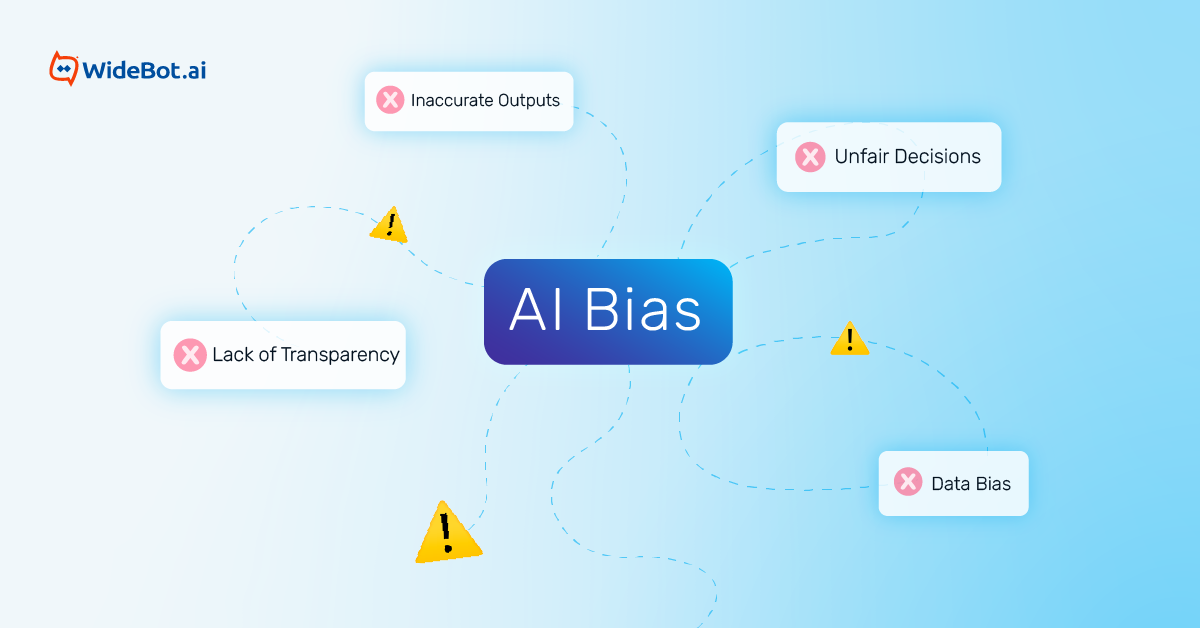
AI Bias refers to the tendency of an artificial intelligence model to make unfair or inaccurate decisions toward a particular group of people or set of values due to flaws in the data or in the model's design.
A simple example: if an AI model is trained on hiring data where most successful candidates are men, the system may develop a tendency to favor male applicants and overlook female applicants, even when their qualifications are equal.
AI bias differs from human bias in that it can be applied at massive scale and incredible speed, amplifying its negative effects on society. It can also be invisible and difficult to detect, especially in complex systems such as deep neural networks.
Types of AI Bias
1. Historical Bias
Historical bias originates from historical data that reflects the biases of past societies. Even if the data is accurate, it may still be built upon inherently biased social systems, such as datasets that favor white populations while discriminating against Black communities.
2. Representation Bias
Representation bias occurs when data lacks diversity or fails to fairly represent all groups. For example, if a training dataset contains significantly more faces from one ethnic group than others, the system will be less accurate when identifying faces from underrepresented groups.
This type of bias can also occur when data is collected from a specific segment of society without fairly representing the broader population.
3. Algorithmic Bias
Algorithmic bias stems from the design of the algorithm itself or from the optimization criteria selected by developers.
It refers to bias introduced through decisions made during algorithm development, such as assigning greater weight to certain variables while neglecting others.
4. Interpretation Bias
Interpretation bias occurs when humans interpret AI outputs in a biased way, or when model results are misunderstood or distorted, leading to biased decisions even when the outputs themselves are fair.
Causes of AI Bias
1. Data Bias
Biased data is considered the most common cause of AI bias.
The data used to train a model may fail to represent all groups equally. Such data may be:
- Incomplete: lacking representation of certain groups.
- Inaccurate: containing systematic errors.
- Historically biased: reflecting biases that existed in society.
- Imbalanced: favoring one group over another.
2. Bias Within Development Teams
When AI development teams lack diversity, they may miss important perspectives and fail to identify potential biases.
This can lead to:
- Failure to understand the needs of different groups.
- Selection of incomplete evaluation criteria.
- Lack of awareness of potential negative impacts.
3. Bias in Variable Selection
Choosing the right variables for model training is critical.
Using variables that correlate with sensitive attributes (such as postal codes serving as proxies for ethnicity) can result in unintended bias.
4. Bias in Problem Definition
The way a problem is defined and objectives are established can influence outcomes.
For example, if "success" is defined in a way that favors a specific group, the system will learn and reproduce that bias.
Real-World Examples of AI Bias
1. Bias in Hiring
Example: Amazon's Recruitment System
In 2018, Amazon developed an automated résumé-screening system. However, it favored male candidates because it had been trained primarily on résumés submitted by men in technical roles.
Amazon later discovered that its recruitment algorithm exhibited bias against women, particularly for technical positions.
2. Bias in Criminal Justice Systems
Example: The COMPAS Risk Assessment System
U.S. courts used the COMPAS system to predict the likelihood of criminal reoffending.
Studies revealed that the system was more likely to classify African American defendants as "high risk" compared to white defendants.
3. Bias in Facial Recognition
Example: Commercial Facial Recognition Systems
A study conducted by MIT found that commercial facial recognition systems were significantly less accurate when identifying women with darker skin tones, showing error rates as high as 34.7%, compared with only 0.8% for lighter-skinned men.
Additional studies have shown that some facial recognition algorithms perform substantially worse when analyzing women or people with darker skin because these groups were underrepresented in training datasets.
4. Bias in Lending Decisions
Example: Credit Scoring Algorithms
Banks use algorithms to evaluate loan applications.
Some credit-scoring systems have demonstrated bias against racial minorities due to reliance on historical data shaped by social and economic inequalities.
In certain cases, these systems produced less favorable outcomes for minority groups despite similar financial circumstances.
5. Bias in Healthcare
Example: Disease Diagnosis Algorithms
Using datasets that fail to adequately represent specific populations can lead to unfair outcomes in disease diagnosis and treatment recommendations.
How Can We Address AI Bias?
1. Improving Data Quality
Data Diversification
- Collect diverse datasets that represent all groups.
- Gather more comprehensive and representative data across all demographic categories, including race, gender, age, economic background, and more.
- Ensure balanced representation.
- Use data augmentation techniques for underrepresented datasets.
Data Cleaning
- Remove variables that may introduce bias.
- Examine datasets for biased patterns.
- Apply data quality assurance techniques.
Data Transparency
- Document data sources and collection methods.
- Disclose limitations and potential biases.
- Allow data to be independently reviewed.
2. Developing Fair Algorithms
Fair Learning Techniques
- Incorporate fairness constraints into the cost function.
- Use adversarial networks to reduce bias.
- Apply multi-objective optimization that includes fairness considerations.
Post-Processing Techniques
- Adjust outputs to ensure fairness.
- Apply different thresholds for different groups when appropriate.
- Recalibrate model outputs.
Debiasing Techniques
There are algorithms and techniques that can be used to reduce the impact of bias within both datasets and models.
3. Diversifying Development Teams
The Importance of Diversity
- Include individuals from different backgrounds.
- Encourage diverse perspectives.
- Increase awareness of bias.
Training and Awareness
- Train developers to identify bias.
- Conduct workshops on fairness in artificial intelligence.
- Foster a culture that values diversity and inclusion.
4. Testing Models and Developing Fairness Metrics
Bias Testing
Regularly analyze model outputs to determine whether the system is making unfair decisions toward a particular group and correct issues when necessary.
Types of Fairness Metrics
- Demographic Parity: Equal outcome rates across groups.
- Equalized Odds: Equal error rates across groups.
- Individual Fairness: Similar treatment for similar individuals.
Measurement Challenges
- Balancing different fairness metrics.
- Defining fairness within a specific context.
- Measuring long-term impact.
5. Ethical Design and Governance
Ethical Design
Involve ethics specialists and representatives of affected groups during model development to ensure fairness is considered from the outset.
Policy Development
- Develop guidelines for fair AI.
- Establish ethics review committees.
- Define industry-wide fairness standards.
Review and Auditing
- Conduct regular system audits.
- Use bias analysis tools.
- Continuously evaluate performance.
Transparency and Accountability
- Explain how systems operate.
- Document how models are built and what decisions were made during development.
- Allow external audits by independent experts.
- Disclose limitations and potential biases.
- Establish mechanisms for complaints and remediation.
6. Advanced Techniques
Federated Learning
- Train models on distributed datasets.
- Reduce bias through greater diversity.
- Protect privacy during training.
Multi-Task Learning
- Train models on multiple tasks simultaneously.
- Improve generalization and fairness.
- Reduce over-specialization.
Explainable Learning
- Understand how decisions are made.
- Identify sources of bias.
- Increase trust in AI systems.
Future Challenges
Technical Challenges
- Developing more accurate fairness metrics.
- Balancing performance and fairness.
- Addressing bias in large-scale datasets.
Social Challenges
- Defining fairness across different cultural and societal contexts.
- Addressing cultural biases.
- Ensuring inclusivity in technology.
Legal and Ethical Challenges
- Developing legal frameworks for fair AI.
- Balancing innovation with protection.
- Determining accountability for harms caused by AI systems.
Conclusion
Artificial intelligence is not inherently neutral. Rather, it reflects the reality on which it is trained. Therefore, we must approach AI bias with awareness and responsibility.
While technical solutions play an important role, addressing bias also requires collaboration among data scientists, ethics experts, policymakers, and all those who may be affected by these systems.
Successfully addressing AI bias requires:
- Awareness: Understanding the forms and causes of bias.
- Commitment: Allocating the necessary resources to address it.
- Collaboration: Working across disciplines and areas of expertise.
- Continuity: Maintaining ongoing monitoring and improvement.
Ultimately, building fair AI is not merely a technical challenge—it is an ethical commitment toward a more equitable and inclusive society. By working together, we can develop intelligent systems that serve everyone fairly and contribute to a better future for humanity.
FAQ’s about AI bias:
1. What is AI bias?
AI bias is the tendency of an AI model to produce unfair or inaccurate decisions toward certain groups due to flaws in training data, algorithm design, or human interpretation; often amplified at massive scale.
2. What are the main types of AI bias?
The four main types are historical bias, representation bias, algorithmic bias, and interpretation bias; each rooted in a different stage of the AI development and deployment lifecycle.
3. What causes AI systems to become biased?
Biased or incomplete training data, lack of diversity in development teams, poor variable selection, and flawed problem definitions are the most common causes of AI bias.
4. Can you give real examples of AI bias?
Yes, Amazon's recruitment AI favored male candidates, the COMPAS justice system over-flagged African American defendants, and commercial facial recognition systems showed error rates up to 34.7% for darker-skinned women.
5. How can enterprises reduce AI bias?
By using diverse and representative training data, building inclusive development teams, auditing models regularly, applying fairness metrics, and aligning with responsible AI governance frameworks.




.webp)
.webp)
.webp)
