
Governments in Saudi Arabia and across the Middle East face a growing challenge in the era of big data. Every day, hundreds of thousands of documents, laws, regulations, and reports accumulate across ministries and government institutions. How can an employee at the Ministry of Justice quickly and accurately find the required legal provision among thousands of legal texts? How can an official at the General Authority for Statistics extract the correct information from reports spanning multiple years without making errors?
This challenge is not merely an organizational issue—it directly affects the foundation of trust between citizens and government. When a digital government provides incorrect or inaccurate information to citizens, it impacts the credibility of the entire system. This is where Government RAG Models emerge as an advanced technological solution that ensures data accuracy and data transparency in the public sector.
Traditional AI models, despite their capabilities, suffer from a fundamental limitation in government environments: they rely on pre-trained information that may be outdated or inaccurate. Government AI powered by RAG technology introduces a revolutionary approach that combines the power of artificial intelligence with the reliability of up-to-date official sources.
In this article, we explore this technology in detail.
Understanding Government RAG Models: The Next Generation of Government Data Extraction
What Is RAG Technology?
RAG stands for Retrieval-Augmented Generation, an advanced government AI technology that combines two core processes:
Phase One: Retrieval
The system intelligently searches vast government databases to find the information and documents most relevant to a query.
Imagine a Ministry of Interior employee searching for a specific regulation. Instead of manually reviewing hundreds of files, the system identifies the relevant documents in seconds.
Phase Two: Generation
After retrieving the appropriate information, the system processes it and generates a comprehensive and accurate response in Arabic, while citing the original sources of the information.
A Simple Analogy to Understand RAG
To better understand how Government RAG Models work, imagine the difference between a government employee relying solely on memory and another who has instant access to a comprehensive and continuously updated archive:
- Traditional employee (legacy models): Answers questions from memory, which can sometimes result in outdated or inaccurate information.
- RAG-powered employee: Searches the complete archive first, retrieves the latest information, and then provides a response based on trusted and up-to-date sources.
This approach ensures that every answer is supported by official documents and approved sources, delivering the level of data transparency required in the government sector.
WideBot AI provides RAG models specifically designed for Arab governments, tailored to their operational needs while ensuring data transparency and privacy.
Learn more about WideBot AI’s products and solutions.
Why Are RAG Models the Ideal Solution for Digital Government?
1. Ensuring Information Accuracy in Government Environments
Data accuracy is a top priority in the public sector. When a citizen requests information about a government procedure, or when a government employee needs a specific legal reference, accuracy is not simply an added benefit; it is essential.
Government RAG Models address this challenge through:
- Direct integration with official sources: The system retrieves information only from approved government databases.
- Continuous updates: Whenever a regulation or law is updated, it becomes immediately available to the system.
- Traceability and auditability: Every response is linked to its original source, enabling verification and review.
Practical example: At the Saudi Ministry of Justice, a RAG system can answer a lawyer’s inquiry about a specific legal article—not only by providing the full text, but also by highlighting any recent amendments and linking it to related cases.
2. Achieving Complete Information Transparency
.webp)
Data transparency is a key pillar of Saudi Vision 2030, and RAG models support it through:
- Displaying sources for every piece of information.
- Explaining how a specific answer was generated.
- Maintaining a complete audit trail of all queries and interactions.
Practical Municipal Application
When a citizen asks about obtaining a building permit, the system can provide:
- The original regulation text.
- The date of the latest update.
- The authority responsible for the update.
- Similar cases that were previously handled.
3. Information Security and Privacy in the Public Sector
Information security in government environments requires exceptional levels of protection.
Government RAG Models provide:
- Full control over data: Information remains within secure government networks.
- Role-based access controls: Employees can only access authorized information.
- Advanced encryption: Protecting data throughout processing and storage stages.
Example in the Ministry of Health: A RAG system can grant authorized physicians access to patient records while restricting sensitive personal information from administrative staff, all while maintaining a complete access log.
4. Eliminating AI Hallucinations
One of the biggest limitations of traditional AI models is hallucination; the generation of information that does not actually exist.
In government environments, this is completely unacceptable.
Government RAG Models address this challenge by:
- Relying exclusively on trusted sources.
- Retrieving existing information rather than generating unsupported content.
- Acknowledging when information is unavailable instead of fabricating answers.
- Validating information before presenting it.
Practical Applications of RAG Models in the Saudi Public Sector
Ministry of Justice: Transforming Legal Research
Imagine a lawyer working on a complex case who needs to search through thousands of judgments and regulations.
A Ministry of Justice RAG system can:
- Search all Saudi laws and regulations in seconds.
- Link similar cases together.
- Track legislative developments over time.
- Generate accurate summaries of court rulings.
Result: Research time is reduced from days to minutes while ensuring no critical information is overlooked.
General Authority for Statistics: Precision in Economic Data
Accurate statistical data extraction is essential for economic decision-making.
A RAG system can:
- Extract data from reports spanning multiple years.
- Compare statistics across different time periods.
- Connect economic data with government policies.
- Generate comprehensive reports based on specific criteria.
Municipalities: More Effective Citizen Services
Citizens seeking information about obtaining a commercial license can instantly receive:
- A complete list of required documents.
- Current fees and update schedules.
- Expected processing timelines.
- Correct application forms.
- Contact information for relevant officials.
All of this information is retrieved directly from the municipality’s updated database, ensuring accuracy and timeliness.
What Are the Challenges and Solutions in Implementing Government RAG Models?
Challenge 1: Technical Infrastructure
Implementing Government RAG Models requires advanced infrastructure.
Solutions include:
- Investing in local servers to ensure sensitive data is processed on-premises.
- High-speed communication networks for rapid query responses.
- Backup systems to guarantee service continuity.
Challenge 2: Workforce Training
The success of any intelligent system depends on users understanding how to use it.
Digital government initiatives require:
- Comprehensive training programs for employees.
- Specialized workshops to understand system capabilities and limitations.
- Ongoing technical support to ensure optimal usage.
Challenge 3: Data Quality
RAG models depend heavily on the quality of information stored in databases.
Solutions include:
- Cleaning outdated or conflicting data.
- Establishing standardized data-entry practices.
- Conducting regular reviews to ensure accuracy and relevance.
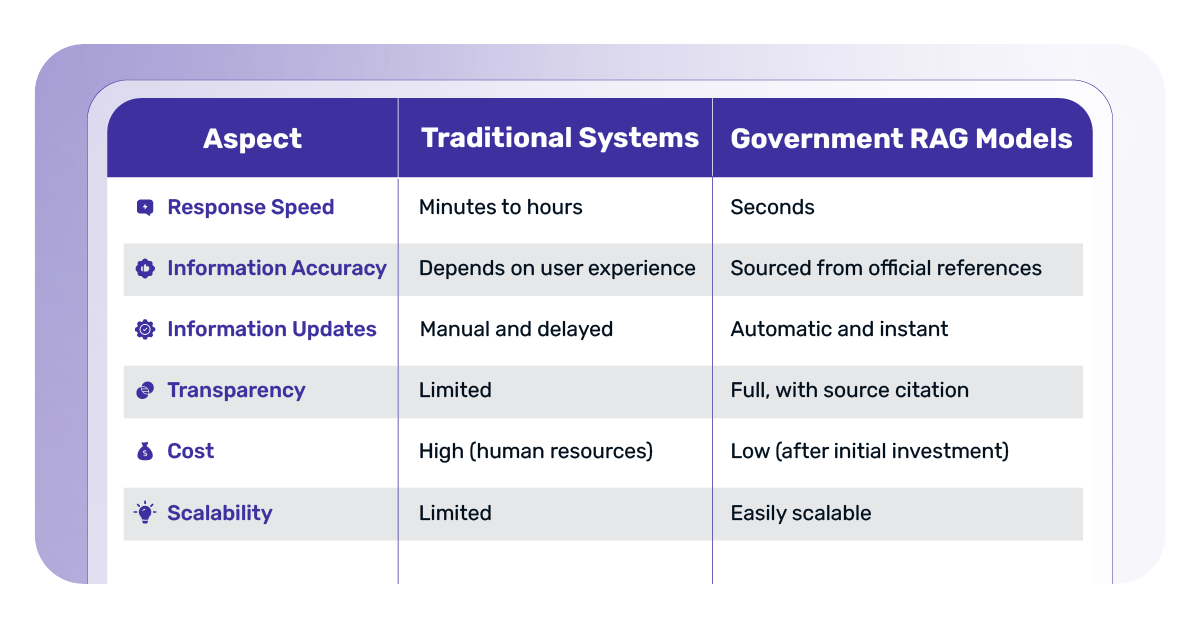
Comprehensive Comparison: RAG Models vs. Traditional Systems
Quick Tips for Implementing RAG Models in Government Institutions
For Leaders and Decision-Makers
- Start with a small pilot project within a single department.
- Invest in technical team training early.
- Establish clear success metrics.
For Technical Teams
- Prioritize data cleansing before implementation.
- Conduct extensive testing before launch.
- Build intuitive and user-friendly interfaces.
For Project Managers
- Allocate sufficient user training time.
- Develop contingency plans for reverting to legacy systems if necessary.
- Continuously monitor performance and user feedback.
The Digital Future: Toward a Smarter and More Transparent Government
Interactive Artificial Intelligence
The future of Government RAG Models is moving toward voice and visual interaction.
Imagine a citizen who can:
- Ask questions in Arabic using voice.
- Receive interactive visual responses.
- Download required documents directly from the system.
Integration with the Internet of Things (IoT)
Future digital governments will integrate RAG systems with sensors and smart infrastructure to:
- Monitor air quality and connect insights to environmental policies.
- Analyze traffic patterns and automatically update regulations.
- Continuously monitor and improve public services.
Continuous Learning and Self-Improvement
Future RAG systems will learn from daily interactions to:
- Better understand citizens’ real needs.
- Deliver more accurate and detailed responses.
- Recommend improvements to government processes.
Conclusion
Government RAG Models are not simply another emerging technology—they are the foundation of the future digital government.
In a world where technological innovation is accelerating, Saudi government institutions need solutions that ensure data accuracy, enhance data transparency, and meet citizens’ expectations for fast and reliable public services.
Accurate and transparent data extraction is no longer a luxury; it is a necessity for building trust between citizens and government. Government AI powered by RAG technology opens new opportunities to improve public services and strengthen administrative efficiency.
Now is the right time to begin the digital transformation journey.
WideBot AI stands ready to help Saudi government institutions achieve this next stage of transformation.
Are you ready to become part of the future of digital government?
Book a free consultation with WideBot’s experts and discover how RAG Models can transform your government institution into a benchmark for efficiency and transparency.
FAQ's about how RAG Models ensure information accuracy:
How long does it take to implement a RAG system in a government institution?
Implementation timelines vary depending on organizational size and data complexity. Typical projects require approximately 3–6 months for full deployment, while pilot projects can begin within 4–6 weeks.
Do Government RAG Models require a constant internet connection?
No. Government RAG Models can operate entirely within an institution’s local network, ensuring information security without requiring external connectivity.
How do RAG Models ensure information accuracy?
The system relies exclusively on approved official databases and displays the source of every piece of information, allowing verification and review at any time.
What is the cost of implementing a RAG system compared to traditional systems?
Although there is an initial investment, RAG Models generate significant long-term operational savings by reducing reliance on manual processes and improving efficiency.
Can RAG Models be integrated with existing government systems?
Yes. WideBot provides flexible integration capabilities that allow RAG systems to connect with existing government databases and applications without requiring full replacement.
How is data privacy protected in Government RAG systems?
The system applies the highest security standards through advanced encryption, role-based access controls, and secure government-hosted infrastructure.




.webp)
.webp)
.webp)
