
.webp)
Saudi Arabia is investing $100 billion in AI infrastructure development as part of its Vision 2030 ambitions, reinforcing its position as one of the world’s leading AI-driven economies. Through a series of national initiatives, the Kingdom aims to accelerate innovation and sustainable development by embedding artificial intelligence across industries and public services.
With Saudi Arabia ranking 15th globally in AI research in 2025, according to the Global AI Competitiveness Index, the Kingdom’s commitment to placing data and AI at the center of its economic and development agenda is clear. Vision 2030 is not only focused on diversifying revenue streams beyond oil; it also seeks to establish Saudi Arabia as a global hub for data and artificial intelligence.
AI has become a foundational pillar of Vision 2030. According to the Saudi Data and AI Authority (SDAIA), 66 out of 96 Vision 2030 objectives are directly or indirectly linked to data and AI. This reflects a broader reality: digital transformation and artificial intelligence are no longer simply technology initiatives; they are strategic enablers of national growth and competitiveness.
This article explores how AI aligns with the pillars of Saudi Vision 2030, its impact on key sectors, and the opportunities it creates for businesses operating in the Kingdom.
AI and Saudi Vision 2030: A Comprehensive Analysis
1. Strategic Alignment
Saudi Vision 2030 aims to reduce dependence on oil while creating a diversified, innovation-driven economy. Artificial intelligence is a critical enabler of this transformation and has been identified as one of the Kingdom’s most important future economic drivers.
To accelerate this agenda, Saudi Arabia established the Saudi Data and AI Authority (SDAIA) to develop data policies, AI strategies, and the infrastructure required to support nationwide adoption.
2. AI as a Driver of Vision 2030’s Three Pillars Artificial intelligence plays a central role in advancing the three core pillars of Vision 2030:
- A Thriving Economy
- A Vibrant Society
- An Ambitious Nation
Its ability to predict outcomes, analyze vast datasets, and support data-driven decision-making makes AI a powerful engine for national development.
A Thriving Economy: AI as a Growth Engine
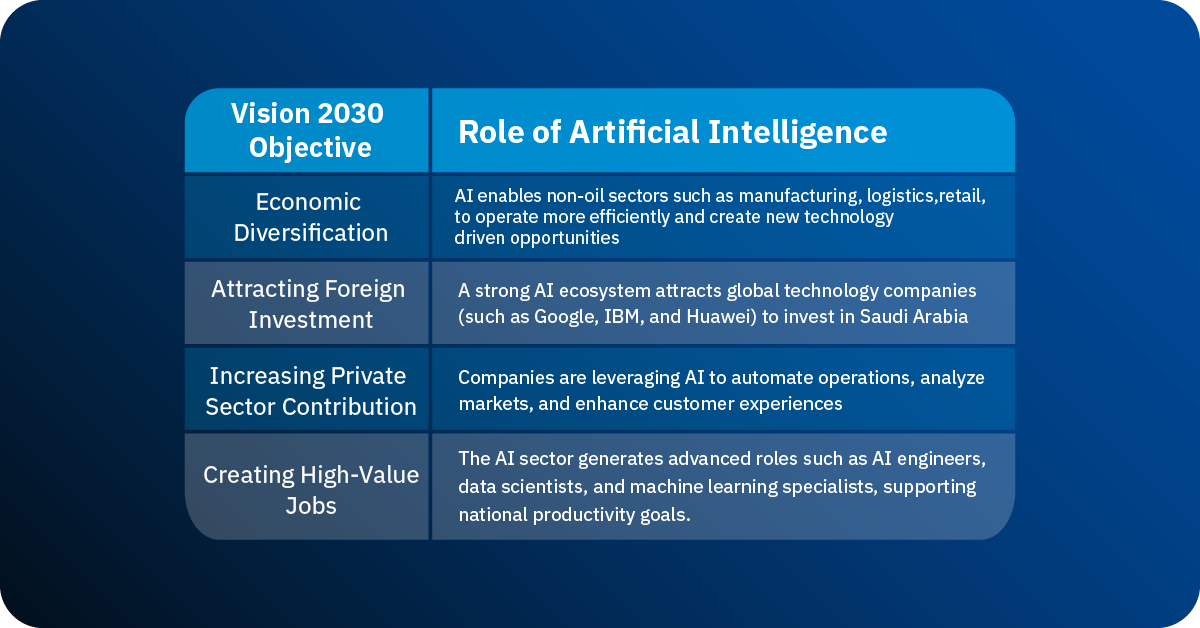
AI supports economic diversification by improving productivity, reducing waste, optimizing supply chains, and creating new opportunities for highly skilled employment. It also strengthens local innovation ecosystems and contributes to increasing the share of non-oil sectors in GDP.
AI is expected to contribute approximately $135 billion (SAR 510 billion) to Saudi Arabia’s GDP by 2030.
A Vibrant Society: Enhancing Quality of Life
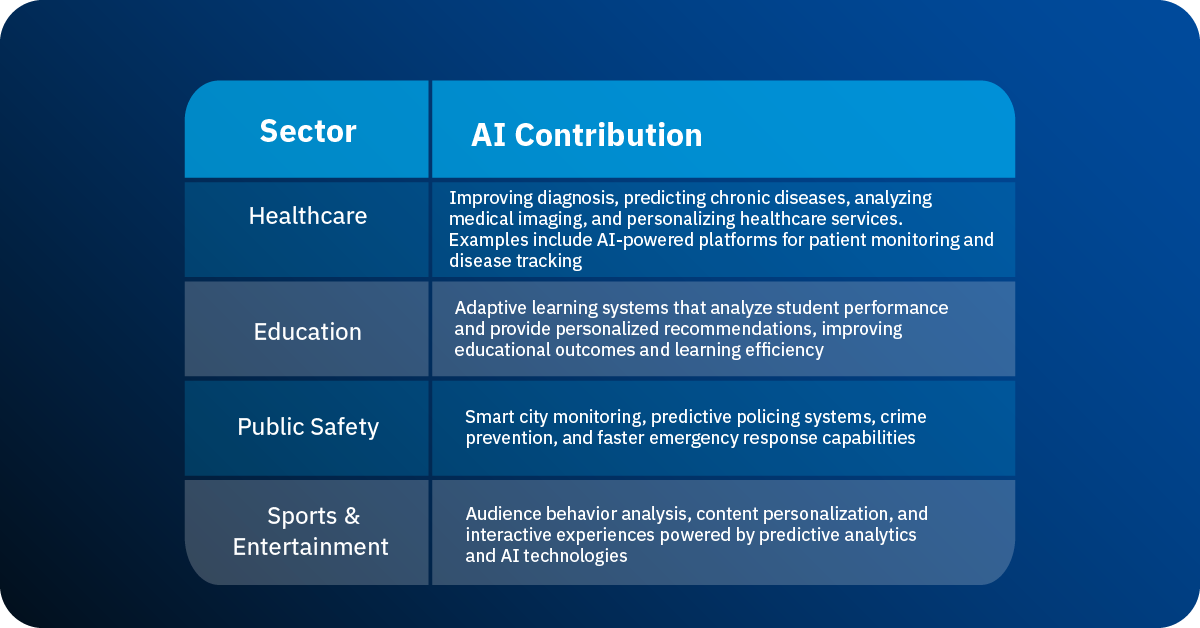
AI-powered solutions are transforming healthcare, education, transportation, and housing.
Smart systems help reduce traffic accidents through predictive monitoring, while AI-driven healthcare solutions enable proactive patient care based on data analysis. Platforms such as Sehhaty demonstrate how AI can improve access to healthcare services and patient outcomes across the Kingdom.
AI helps create a healthier, more connected society through intelligent digital services that save time and improve quality of life.
An Ambitious Nation: Intelligent Digital Governance
AI enhances government performance by increasing efficiency, transparency, and accountability.
Machine learning systems can detect irregularities in government transactions, support fraud prevention, and enable more informed decision-making. For example, the Zakat, Tax and Customs Authority uses AI and machine learning to improve tax auditing processes and identify potential irregularities.
Saudi Arabia ranks among the world’s leading nations in adopting data-driven and AI-powered governance.
3. National AI Initiatives and Strategies
Several major initiatives are accelerating AI adoption across the Kingdom:
- National Strategy for Data and AI (NDSAI): Aims to position Saudi Arabia among the world’s top 15 AI nations by 2030.
- Global AI Summit (GAIS): Organized by SDAIA to foster international collaboration and showcase Saudi Arabia’s AI capabilities.
- Human Capability Development Program: Supports AI talent development and innovation.
- NEOM: A flagship example of large-scale integration between AI and urban planning.
4. Strengthening the National Innovation Ecosystem
AI enables universities and research institutions to analyze vast amounts of scientific data, accelerating discovery and innovation.
The King Abdullah University of Science and Technology (KAUST) is a leading example, leveraging AI to develop predictive models in marine science and energy research.
5. Supporting National Security
AI technologies are increasingly used in surveillance systems, threat analysis, emergency response, and disaster management.
Initiatives such as the Saher traffic monitoring system use computer vision technologies to detect violations and improve road safety.
6. Advancing Environmental Sustainability
AI supports environmental objectives through:
- Smart air-quality monitoring systems
- Intelligent agriculture solutions
- Water resource optimization
- Renewable energy management
Projects such as the Sakaka Solar Power Plant demonstrate how AI can improve renewable energy performance through predictive analytics and operational optimization.
7. Existing Challenges
Despite significant progress, organizations continue to face challenges related to talent development, implementation speed, governance frameworks, and scaling AI initiatives across sectors.
How AI Is Driving Progress Across Strategic Sectors in Saudi Arabia
Government Sector
Through the National Transformation Program, AI is helping government entities deliver faster, more efficient services.
Applications include:
- AI-powered customer service assistants
- Citizen sentiment analysis
- Predictive infrastructure monitoring
- Data-driven policy development
These technologies support government leaders in making more accurate and informed decisions.
Healthcare
The Health Sector Transformation Program is accelerating AI adoption in:
- Early disease detection
- Medical records management
- Chronic disease monitoring
- Resource optimization
AI can also reduce emergency department wait times through predictive demand forecasting and intelligent resource allocation.
Globally, AI has the potential to generate up to $150 billion annually in healthcare savings, highlighting its transformative potential.
Education
As part of the Human Capability Development Program, AI is enhancing educational outcomes through:
- Adaptive learning systems
- Personalized educational content
- Student performance analytics
- Intelligent tutoring solutions
AI-powered educational technologies help identify learning gaps, support teachers, and improve overall academic performance.
Studies suggest that AI applications can improve education quality by as much as 40% in developing environments.
Banking and Insurance
The Financial Sector Development Program encourages AI adoption across financial services.
Key applications include:
- Risk assessment
- Fraud detection
- Personalized financial services
- Intelligent customer engagement
Banks increasingly use AI to identify unusual transaction patterns and enhance compliance while improving customer experiences through conversational AI solutions.
Energy
The National Industrial Development and Logistics Program supports AI integration within energy operations.
AI enables:
- Predictive maintenance
- Energy demand forecasting
- Grid optimization
- Carbon emissions reduction
- Renewable energy performance monitoring
Organizations that adopt AI in energy operations can achieve significant cost savings while improving production efficiency.
Future Opportunities for Businesses
As Saudi Arabia continues to strengthen its AI ecosystem, private-sector organizations have unprecedented opportunities to integrate AI into their operations.
According to PwC, AI could contribute $135 billion to Saudi Arabia’s economy by 2030, representing approximately 12.4% of GDP.
1. Developing Intelligent Products and Services
Businesses across retail, tourism, telecommunications, manufacturing, and other industries can use AI to analyze customer behavior and deliver highly personalized experiences.
For example, AI-powered personalization can help organizations improve customer satisfaction and increase engagement.
2. Optimizing Internal Operations
AI enables organizations to automate repetitive processes, improve operational efficiency, reduce costs, and accelerate decision-making.
Research indicates that AI-driven automation can reduce operating costs by approximately 20–30%.
3. Elevating Customer Experience
Organizations can leverage AI to provide:
- 24/7 customer support
- Personalized recommendations
- Proactive customer engagement
- Faster issue resolution
These capabilities strengthen customer loyalty and improve service quality.
4. Enabling Strategic Decision-Making
Advanced analytics powered by AI helps organizations:
- Forecast market trends
- Identify investment opportunities
- Manage risks proactively
- Respond quickly to market changes
According to Gartner, leading organizations increasingly view advanced analytics and data intelligence as critical drivers of future business strategy.
Conclusion
Artificial intelligence is no longer simply a supporting technology; it is a core enabler of Saudi Arabia’s Vision 2030.
From government efficiency and healthcare innovation to educational advancement, financial modernization, and sustainable energy development, AI is helping shape the Kingdom’s future across every major sector.
What makes the Saudi model particularly compelling is the alignment between technology investment and national ambition. AI is not being adopted solely as an economic opportunity; it is being embraced as a development imperative that supports long-term prosperity, competitiveness, and societal progress.
With strong government support, a rapidly evolving digital infrastructure, and a growing innovation ecosystem, Saudi Arabia is positioning itself as a regional and global leader in artificial intelligence.
For businesses, the message is clear: organizations that invest in AI today will be better positioned to compete tomorrow, contribute to the Kingdom’s digital economy, and create long-term value in an increasingly intelligent future.
Saudi Arabia is not waiting for the future; it is building it through artificial intelligence. The companies that embrace this transformation today will become the leaders of tomorrow’s economy.
FAQs about AI in Saudi Vision 2030:
1. How does AI support Saudi Vision 2030?
AI is a core enabler of Vision 2030, linked to 66 of its 96 objectives. It drives economic diversification, improves public services, modernizes governance, and is projected to contribute $135 billion to Saudi GDP by 2030.
2. Which sectors benefit most from AI in Saudi Arabia?
Government, healthcare, education, banking and insurance, and energy are the leading sectors, each tied to a national transformation program adopting AI for efficiency, personalization, and data-driven decision-making.
3. What are the main Saudi national AI initiatives?
Key initiatives include the National Strategy for Data and AI (NDSAI), the Global AI Summit (GAIS), SDAIA programs, the Human Capability Development Program, and flagship projects like NEOM integrating AI into urban planning.
4. What opportunities does AI create for businesses in Saudi Arabia?
Businesses can build intelligent products, automate operations to cut costs by 20–30%, elevate customer experience through 24/7 AI engagement, and use advanced analytics for faster, smarter strategic decisions.
5. What challenges should organizations expect when adopting AI?
Talent development, governance frameworks, implementation speed, and scaling across business units remain the main challenges; requiring clear strategy, the right partners, and ongoing investment in capability building.




.webp)
.webp)
.webp)
